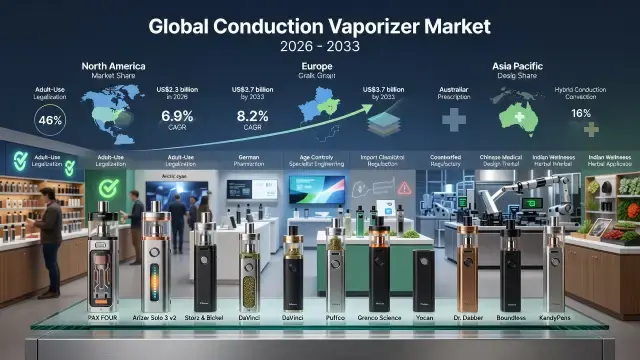
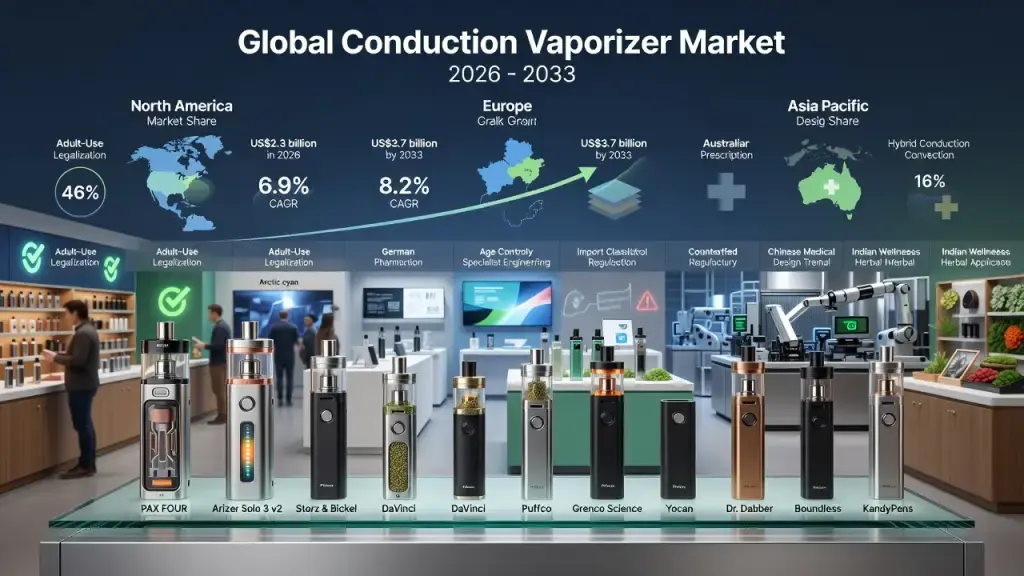
Persistence Market Research puts the global conduction vaporizer market at US$2.3 billion in 2026, climbing to US$3.7 billion by 2033 on a 6.9% compound annual growth rate. That's steady expansion, not explosive - and for manufacturers, distributors, and the retailers who stock these devices, the real story is how uneven that growth will be across regions, product tiers, and regulatory regimes.
A Simple Heating Method, A Complicated Market
Conduction vaporizers heat botanical material through direct contact with a heated chamber. It's a straightforward engineering approach - fewer moving parts, faster heat-up, compact form factors - which is exactly why portable units have become the dominant product type and dry herb the leading material category. Recreational consumers make up the bulk of demand, according to the research firm's breakdown, which tells operators something practical: this is largely a consumer-electronics-style purchase decision, driven by price, battery life, and ease of use rather than clinical specification sheets.
But direct-contact heating has a known weakness. When material doesn't sit evenly against the chamber, temperatures swing, and uneven heat can degrade flavor and reduce material efficiency. That's pushing more technically inclined buyers toward convection or hybrid designs - a shift manufacturers can't ignore if they want to hold premium-segment customers.
Regional Divergence Means No Single Playbook
North America is projected to hold 46% of the market in 2026, a position built on established retail networks, adult-use legalization in parts of the U.S. and Canada, and a consumer base that already knows what it's buying. Europe, despite a smaller base, is expected to grow fastest at an 8.2% CAGR through 2033, driven by medical cannabis programs and a cluster of specialist engineering firms. Asia Pacific sits at roughly 16% share with 7.4% projected growth, shaped less by cannabis legalization and more by Australia's medical framework, Chinese manufacturing capacity, and wellness-oriented herbal applications in markets like India where cannabis itself remains restricted.
The takeaway for brands and distributors: a uniform global product strategy doesn't hold up. What works on a dispensary shelf in Colorado isn't automatically compliant - or even marketable - in a German pharmacy channel or an Australian medical supply chain. Age controls, advertising restrictions, import classifications, and the line between consumer and therapeutic products all shift by jurisdiction, and getting that wrong isn't a minor paperwork issue. It can mean seized shipments, blocked listings, or products pulled from distribution entirely.
- Portable devices lead product demand, driven by battery life and compact design
- Dry herb remains the dominant material format over concentrates
- Hybrid conduction-convection designs are gaining ground among experienced users
- Regulatory classification varies sharply by country, affecting marketing and distribution
- Counterfeit products remain a real risk to brand trust and consumer safety
Where the Competitive Pressure Actually Sits
Named players - PAX Labs, Storz & Bickel, Arizer, DaVinci, Puffco, along with Grenco Science, Yocan, Dr. Dabber, Boundless, and KandyPens - compete less on raw heating technology than on reliability and finish. PAX's March 2026 launch of the PAX FOUR, with its updated hybrid heating system, and Arizer's Solo 3 v2, which added convection to its conduction base along with use-while-charging capability, both point to the same pressure: consumers want devices that behave consistently across a session, not just on the spec sheet.
That consistency matters for more than user satisfaction. Battery reliability, chamber material (ceramic and zirconia options are becoming standard differentiators), and component availability directly affect warranty costs and after-sales support burden - real line items for any company selling through specialist retail or regulated dispensary channels. Cheap counterfeit units undercut pricing but also undercut consumer confidence industry-wide, which is a cost legitimate manufacturers end up absorbing indirectly.
What This Means for Retail and Compliance Teams
For dispensary buyers and wholesale accounts, the practical questions aren't about market size - they're about which SKUs move, which require the least return handling, and which manufacturers provide documentation that satisfies local product-safety and age-restriction requirements. Replacement parts, warranty terms, and clear separation between recreational and any wellness-marketed product lines will matter more as regulators pay closer attention to advertising claims and device classification. Growth here is real, but it's incremental and regionally fragmented - not a rising tide that lifts every device equally.