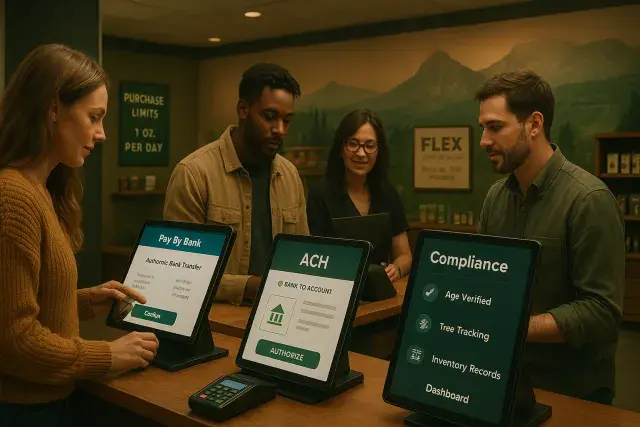
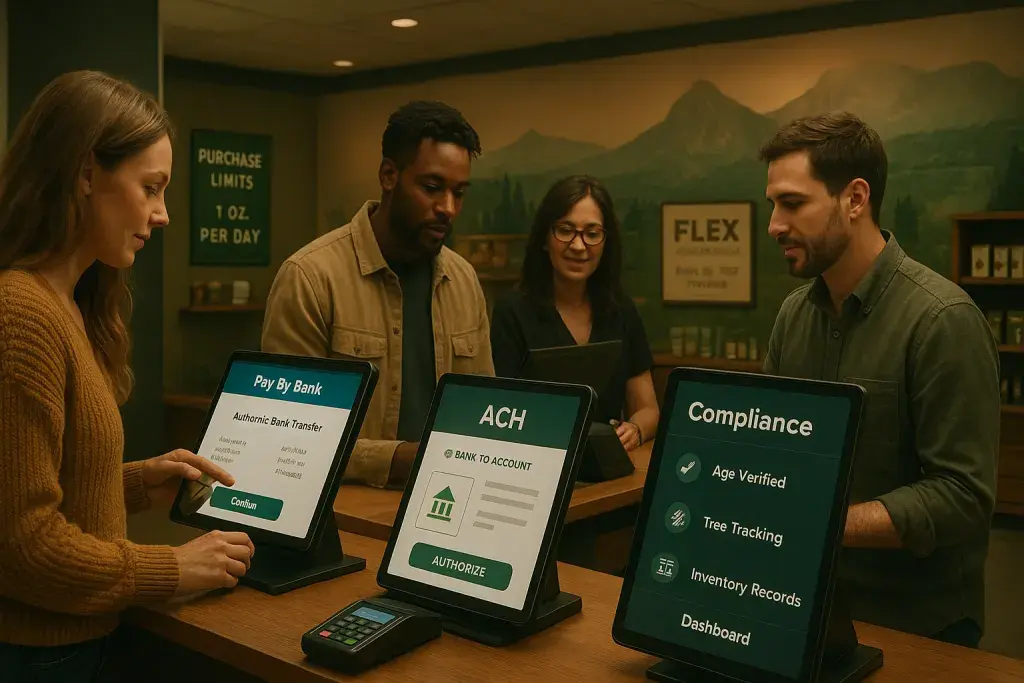
Cannabis operators have lived with payment friction for years - cash-heavy drawers, PIN debit workarounds, and compliance exposure baked into nearly every transaction. FLEX Payment Solutions, a family-owned fintech company and five-time Inc. 5000 honoree, recently expanded its Pay By Bank solution into cannabis retail, offering licensed dispensaries a bank-to-bank digital payment option that is designed to be compliant and legally supported. For an industry that still struggles to access standard merchant services, that framing matters.
The mechanics are straightforward: a consumer authorizes a transaction directly from their bank account through a digital interface, bypassing the card networks entirely. No Visa, no Mastercard, no interchange - just an account-to-account transfer. That structure sidesteps some of the compliance pressure that causes card processors to exit the cannabis space when risk appetite shifts. Operators running tightly integrated POS environments - whether in adult-use markets like Colorado or emerging programs where operators are researching marijuana pos software alaska to build out their compliance stack - understand how payment layer decisions ripple across the entire transaction record, from seed-to-sale tracking to end-of-day reconciliation.
Here's the catch that every dispensary operator should think through: the compliance value of any payment solution depends on how it interacts with state-level reporting obligations and banking relationships. Pay By Bank works through ACH-style bank-to-bank infrastructure. That does not make it invisible to regulators - it makes it traceable, which is actually the point. Regulators and cannabis-friendly financial institutions generally prefer documented, auditable transaction flows over cash or gray-area card schemes. A solution built around direct bank authorization fits that preference more cleanly than many alternatives currently on the market.
Why Payment Optionality Matters in Licensed Cannabis Retail
Dispensary economics are complicated by a tax structure that most retailers never face. Section 280E of the Internal Revenue Code disallows standard business deductions for cannabis operators, which compresses margins and puts pressure on every cost center - including payment acceptance. High per-transaction fees eat directly into thin margins. Pay By Bank, according to FLEX, is designed to lower payment acceptance costs compared to traditional card processing. For a multi-location operator processing significant daily volume, even modest per-transaction savings compound meaningfully over a fiscal year.
Beyond cost, there's a consumer behavior argument. Not every dispensary customer wants to use a debit card, and some remain uncomfortable with cash. Offering a direct bank payment option at checkout - through a simple digital experience rather than a clunky workaround - broadens the operator's ability to close sales without friction. In regulated retail, friction at the register doesn't just lose a sale; it can push consumers toward unlicensed markets, which undercuts the whole compliance argument for adult-use legalization.
Where FLEX Positions This in a Broader Payment Ecosystem
FLEX Payment Solutions has built its product stack around specialized industries - cannabis, CBD, consumer finance, credit unions - rather than chasing mainstream merchant services volume. That focus matters. A payment provider that understands the difference between a COA requirement and a standard product disclosure, or knows why a cannabis operator cannot simply open a standard merchant account, brings different institutional knowledge to the table than a generalist processor retrofitting a solution.
Pay By Bank sits alongside ACH processing, card processing solutions, text payments, IVR payments, instant funding technologies, and payment gateway integrations in the FLEX ecosystem. For dispensary operators evaluating payment infrastructure, that breadth means fewer vendor relationships to manage - which has real operational value when compliance documentation, reconciliation, and banking relationships already consume significant back-office bandwidth.
Practical Considerations for Dispensary Operators
No payment solution eliminates all risk in cannabis retail. State-level compliance obligations - age verification, purchase limits, inventory tracking, packaging standards - remain the operator's responsibility regardless of which payment method a customer uses at checkout. What Pay By Bank addresses is a specific gap: the absence of a reliable, compliant, bank-connected digital payment option that doesn't depend on card network tolerance of cannabis transactions.
Operators considering this solution should evaluate how it integrates with existing POS systems and seed-to-sale platforms, whether their state-licensed banking partner accepts account-to-account transaction flows from cannabis businesses, and how the transaction data maps to their compliance reporting requirements. Those are the right questions - not whether the technology is elegant, but whether it holds up under audit.
The broader trend here is real. Account-to-account payments are gaining traction across multiple specialized industries, and cannabis retail - with its persistent banking access challenges - has more to gain from this shift than most. Pay By Bank doesn't solve every payment problem cannabis operators face. What it does is add one more legitimate tool to a very short list.