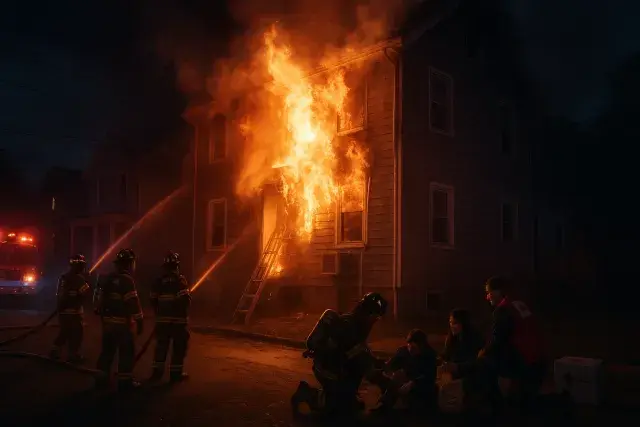
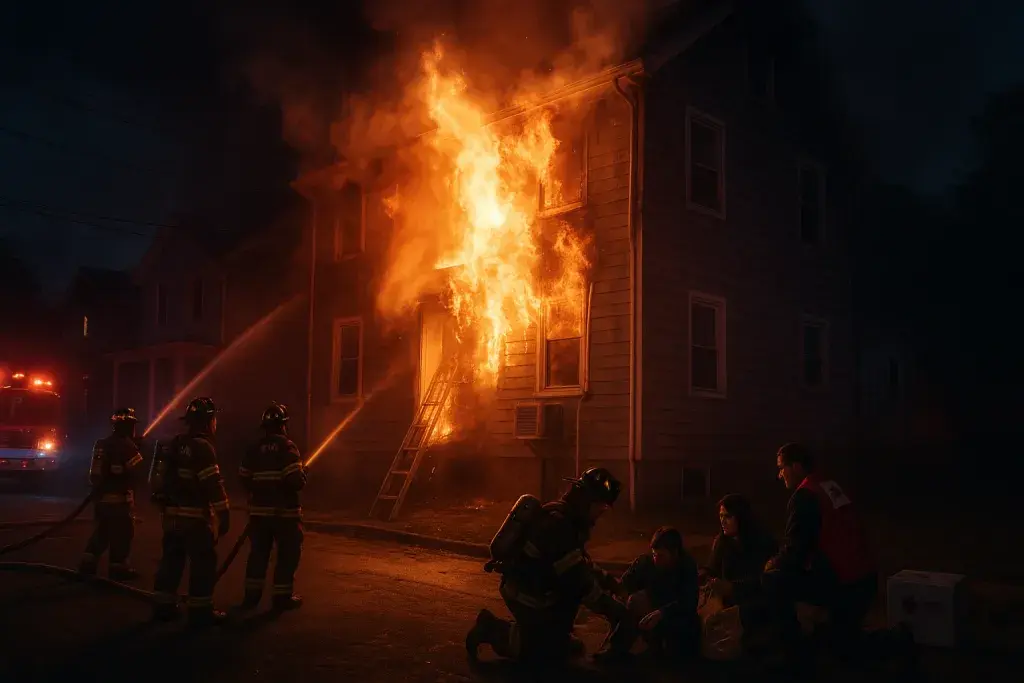
A pre-dawn fire tore through a duplex at 141-143 Chestnut Street in Red Bank, New Jersey early Thursday morning, displacing two families and drawing mutual aid from five surrounding fire departments. Fire Chief Michael Welsh confirmed no civilian injuries were reported, though one firefighter required on-scene treatment for exhaustion. The cause remains under active investigation by both the Monmouth County and Red Bank fire marshals.
Welsh said investigators are focusing attention on external air conditioning units as a potential point of origin, given that the fire appears to have started on the building's exterior. Multi-unit residential properties present distinct fire risk profiles - exterior-mounted mechanical equipment, shared walls, and stacked utility systems can all accelerate spread before crews arrive. For property owners and landlords operating in regulated industries, including those managing real estate adjacent to or leased by licensed cannabis businesses, fire risk and building compliance intersect in ways worth understanding; operators looking to learn more about how market-specific operational standards affect property and business continuity have resources available by state. Firefighters received the initial call at 2:33 a.m. and were assisted by units from Middletown, River Plaza, Sea Bright, Little Silver, and Fair Haven.
Monmouth County property records list the owner as Meir Kasnett, with an address in Lakewood. The property was acquired in 2021. The American Red Cross is providing displacement assistance to both affected families.
What the Investigative Focus on AC Units Means for Property Risk
Exterior air conditioning equipment has a well-documented history as an ignition source - particularly older window or split units exposed to weather, deferred maintenance, or electrical faults. The thing is, this kind of fire origin is not unusual in residential properties where HVAC equipment is mounted on wood-framed exteriors without adequate clearance or fire-stopping. When ignition begins outside the envelope of the structure, it can bypass interior smoke detection systems entirely, which is part of why a 2:33 a.m. call for a fully involved duplex carries the risk profile it does.
For commercial landlords - including those leasing space to licensed retail operations - the parallel is direct. Cannabis dispensaries, grow facilities, and processing operations often run significant HVAC loads, sometimes around the clock, to manage temperature, humidity, and odor control. Equipment maintenance schedules, electrical load documentation, and exterior clearance compliance are not incidental details. They are the kind of operational specifics that appear in licensing inspections, insurance underwriting, and - when things go wrong - fire marshal investigations.
Displacement and the Business of Recovery
Two families losing their homes overnight is, plainly, a serious human disruption. The Red Cross involvement signals that the displacement is not temporary or minor. For property investors and owners of multi-unit residential buildings, incidents like this stress-test whether adequate liability coverage, loss-of-rent provisions, and tenant protection policies are actually in place - not just on paper.
The fire marshal investigation will determine whether the AC units were the confirmed cause or simply a working hypothesis. That distinction matters: if equipment failure or improper installation is established, it opens questions about code compliance, inspection history, and potentially product liability. None of those outcomes are fast or tidy.
Mutual Aid as an Operational Model
Five departments responding to a single residential fire is not routine overkill. It reflects how pre-dawn structure fires in dense residential areas demand surge capacity that no single municipal department can sustain alone. River Plaza, Sea Bright, Little Silver, Fair Haven, and Middletown all committed resources to the Chestnut Street response - a reminder that fire suppression, like many regulated operations, depends on cooperative infrastructure that rarely gets attention until it's needed urgently. The one firefighter treated for exhaustion is a data point worth holding: even without civilian casualties, these events extract real physical cost from the crews managing them.