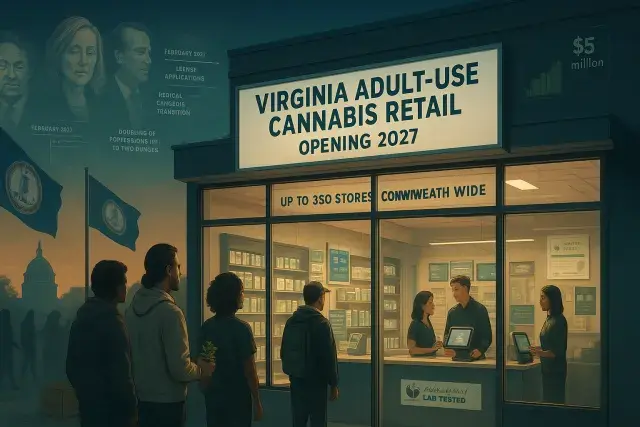
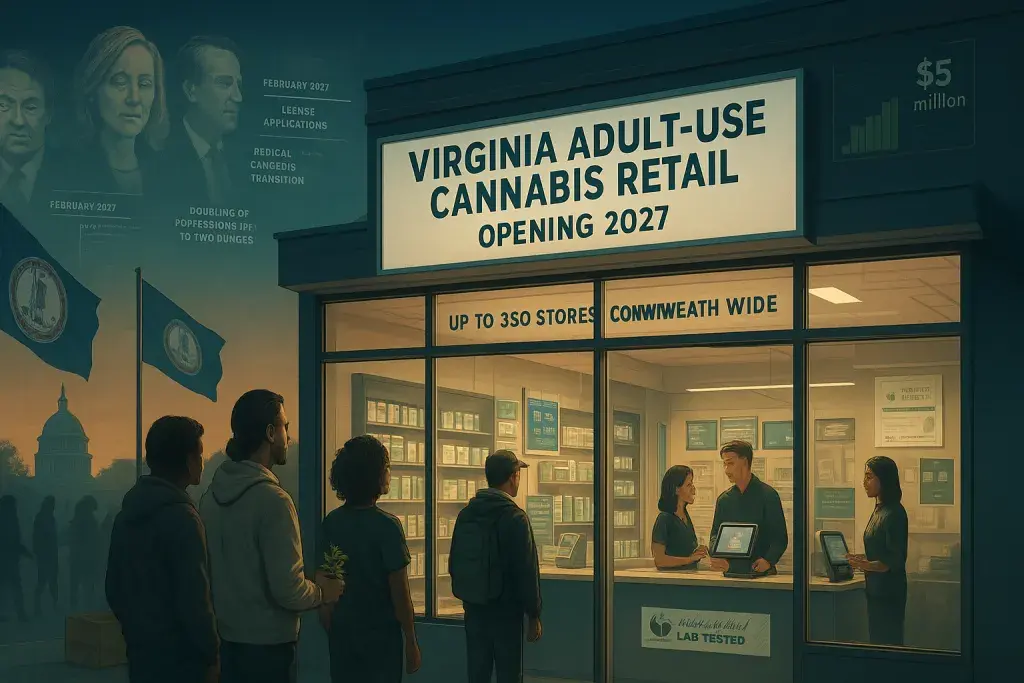
Virginia has cleared the final regulatory hurdle separating legal possession from legal purchase. Under provisions embedded in the state budget signed into law this year, licensed adult-use cannabis retailers will be permitted to open their doors on July 1, 2027, with the state beginning to accept retail license applications in February of that year. Up to 350 stores are expected to operate across the Commonwealth - a significant build-out for a Southern state that, until now, had a legal framework that let residents possess cannabis but gave them no compliant way to buy it.
That gap mattered enormously in practice. Since 2021, Virginia adults could legally hold up to one ounce of cannabis, yet no licensed recreational retailer existed to sell it to them. The result was predictable: the illicit market filled the void. For operators preparing to enter Virginia's adult-use space, that means competing not just against each other but against an entrenched gray and black market accustomed to zero compliance overhead. Getting store infrastructure right before the first transaction processes will be essential - everything from inventory management to a properly configured dispensary pos system capable of handling age verification, seed-to-sale reporting, and excise tax calculations simultaneously. First-mover operational sloppiness, in a market with this kind of illicit competition, is expensive.
Virginia already runs a medical cannabis program, so licensed operators in the medical channel have some institutional familiarity with state compliance requirements - product testing, certificate of analysis documentation, compliant packaging, and METRC-style tracking obligations. But adult-use retail carries its own layer of complexity. The new law doubles the personal possession limit from one ounce to two ounces and continues to allow limited home cultivation. Both provisions affect retail demand projections and SKU planning. A consumer who grows at home and can legally hold two ounces is a different customer than one who relies entirely on a dispensary for supply. Wholesale menu pricing and inventory turn expectations will need to account for that.
Taxation and the Revenue Math Behind the Market
Retail cannabis sales in Virginia will be subject to the state's standard sales tax plus a new cannabis excise tax. State budget estimates project roughly $51 million in combined tax revenue during the program's first year. That figure is a reasonable baseline for a market launching with up to 350 licensed storefronts, though actual collections will depend heavily on how quickly operators get licensed, how fast stores reach operating capacity, and how effectively the legal market displaces illicit sales volume.
For operators, the tax structure has direct implications for retail pricing strategy. Cannabis excise taxes layer on top of the already significant cost burden that licensed retailers carry - compliant packaging, mandatory lab testing, licensing fees, and, critically, the federal tax code's Section 280E provision, which disallows most standard business deductions for companies trafficking in Schedule I controlled substances. Until federal rescheduling changes that calculus, Virginia operators will be pricing products into a market where their effective tax rate sits substantially higher than most comparable retail categories. Competitive pricing against the illicit market, which carries none of those costs, will require real operational efficiency from day one.
Licensing, Timeline, and the Political Path That Got Here
The 2027 launch date reflects how difficult Virginia's legislative path has been. Possession became legal in 2021; a retail framework was supposed to follow. It didn't. Then-Governor Glenn Youngkin vetoed recreational sales legislation in 2024. Governor Abigail Spanberger, who took office in 2025 having campaigned on a regulated retail market, ultimately reached a compromise with lawmakers - one that required rejecting an earlier bill before landing on the version now embedded in the state budget.
The February 2027 application window gives prospective licensees roughly a year to prepare. That timeline is tighter than it sounds. Securing retail real estate in compliant locations, negotiating leases with landlords who understand cannabis-specific zoning requirements, building out store infrastructure, establishing wholesale supply relationships, and completing licensing paperwork all need to happen in sequence. Multi-state operators with existing compliance templates and vendor relationships will have a structural advantage over first-time applicants learning these systems from scratch. State Senator Lashrecse Aird, a Democrat who helped lead the legislation, described the framework as a "smarter and safer path forward" - one that routes consumers toward tested, accurately labeled products and away from unregulated supply chains.
Equity Concerns and the Compliance Tensions Operators Should Watch
Not everyone is celebrating without reservation. Legalization advocates have raised concerns about a provision in the new law that increases the civil fine for public cannabis consumption. The concern is familiar to anyone who has watched adult-use markets open in other states: if enforcement of public consumption rules falls unevenly on minority communities - as it has in several markets - the social equity promise embedded in legalization rhetoric collides directly with on-the-ground policing patterns.
For licensed retailers, this tension has a practical dimension. Operators investing in Virginia's regulated market have a direct interest in enforcement remaining consistent and predictable. Unequal enforcement erodes public trust in the legal framework, complicates community relations, and - in states where social equity licensing provisions exist - can create downstream licensing disputes that slow market development. Virginia operators would be well-served to watch how enforcement of the public consumption provision actually plays out once retail opens, and to engage with local policy conversations rather than treat compliance as purely a back-office function.
Virginia remains one of a small number of Southern states with any form of adult-use legalization. Federal prohibition continues, though recent signals from federal officials suggest a reconsideration of cannabis's Schedule I classification is at least on the table. Rescheduling - even partial - would materially affect the 280E burden and could reshape how banks, payment processors, and insurers engage with cannabis businesses. For operators building Virginia market plans now, that federal variable is real, but it isn't a planning assumption. Build for the current regulatory environment. Treat any federal shift as upside, not a baseline.