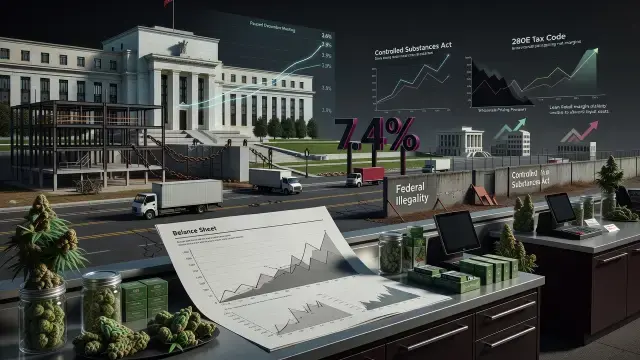
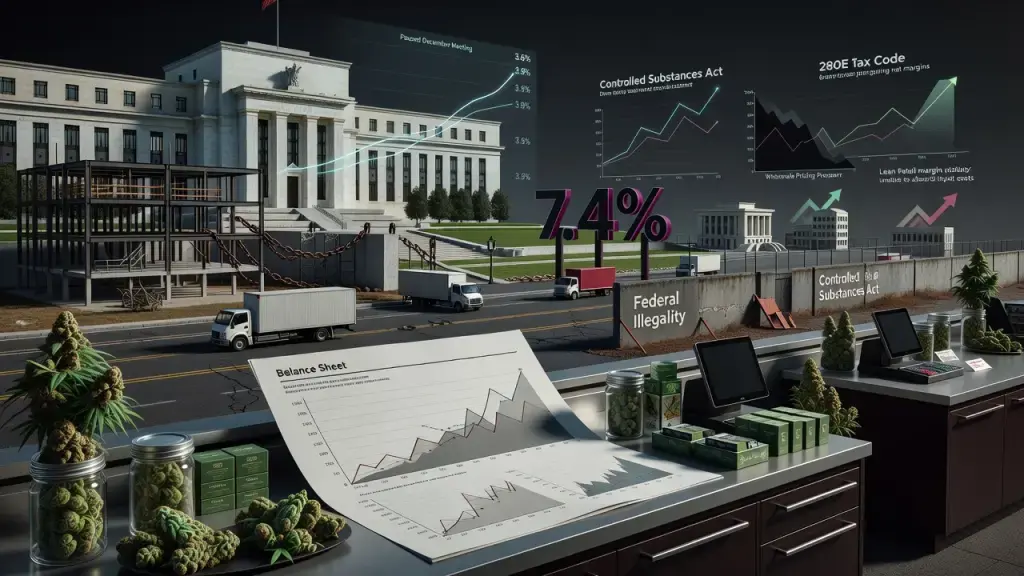
The Federal Reserve's decision to hold interest rates steady this week lands at an awkward moment for an industry that already borrows at a premium. Cannabis retailers and multi-state operators don't get prime lending rates to begin with - federal illegality sees to that - so every basis point the Fed adds or withholds ripples through dispensary balance sheets differently than it does for, say, a liquor store or a pharmacy.
The Fed raised its benchmark rate last month for the first time in three years, moving from roughly 3.6% to 3.9%, and is now expected to pause before its next meeting in December. For plant-touching businesses locked out of traditional banking relationships, that pause offers only partial relief. Most dispensary financing already runs through private credit, sale-leaseback arrangements, or high-interest merchant cash advances rather than conventional commercial loans, so the gap between Fed policy and what cannabis operators actually pay to borrow was already wide before this cycle started.
Why Cannabis Credit Doesn't Track the Fed Cleanly
Here's the catch that non-cannabis lenders don't have to think about: federal scheduling under the Controlled Substances Act keeps most national banks and conventional SBA lending programs out of the space entirely. That forces operators toward a narrower pool of state-chartered banks, credit unions, and private equity, all of which price risk well above whatever the Fed's target rate happens to be. When the broader economy sees mortgage rates climb - the 30-year average hit a three-year high of 7.4% earlier this month, according to the data cited this week - cannabis real estate deals get hit twice. Once by the general cost of capital, and again by the cannabis risk premium layered on top.
That matters for store buildouts, equipment financing, and inventory lines tied to point-of-sale and seed-to-sale tracking systems. A dispensary group planning a second or third location is now weighing construction costs against borrowing terms that would make a conventional retailer wince. Add in 280E, the tax code provision that bars cannabis businesses from deducting ordinary business expenses because of federal scheduling, and the cash-flow squeeze compounds. Operators are paying more to borrow while simultaneously paying a higher effective tax rate than almost any other retail category.
Inflation Pressure Hits the Supply Chain Too
Rising oil and gas prices, tied in this cycle to the Iran war, don't stop at the pump. They show up in delivery manifests, wholesale freight costs, and the price of compliant packaging materials shipped to dispensaries and cultivation facilities. Diesel costs in particular tend to spread through nearly every link of a supply chain that already runs leaner than most retail sectors because of state-by-state transport restrictions and testing requirements.
Wholesale pricing on cannabis flower and extracted products has been under downward pressure in many mature markets for years, a function of oversupply rather than demand. That leaves operators with less room to pass rising input costs on to consumers without further compressing margins that 280E has already thinned out.
What Operators Should Watch Next
The Fed chairman's post-meeting remarks will get parsed closely by anyone tracking credit conditions, cannabis-adjacent or not. A steady rate environment through year-end would be a mild positive for operators with variable-rate debt, but it won't undo the structural financing disadvantages baked into federal cannabis policy.
- Borrowing costs for plant-touching businesses remain elevated regardless of Fed moves, due to limited banking access.
- 280E continues to erode net margins independent of monetary policy.
- Freight and packaging costs tied to energy prices affect wholesale menus and shelf pricing alike.
- Real estate and buildout financing for new dispensary locations face compounding rate and risk premiums.
None of this changes at the state regulatory level - licensing, lab testing, COA requirements, and age-verification rules stay fixed regardless of what the Fed does. But the macro backdrop shapes which operators can afford to expand, refinance, or simply keep the lights on, and this week's pause won't settle that question one way or the other.