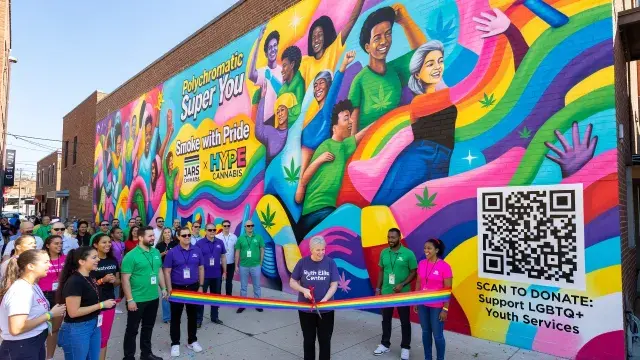
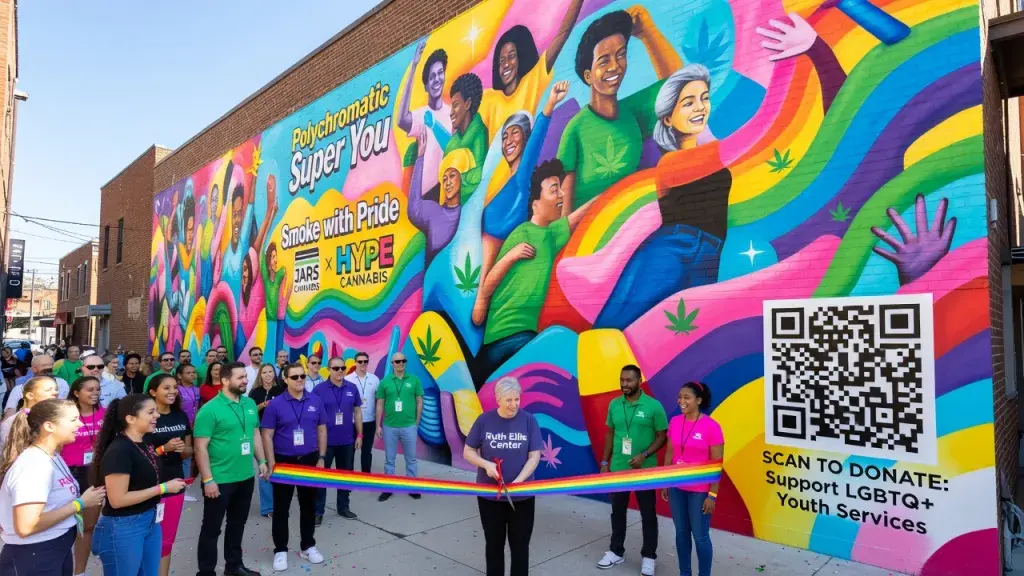
Two Michigan cannabis retailers just put their marketing budgets behind something other than a storefront promotion. JARS Cannabis and HYPE Cannabis held a ribbon-cutting this week for "Polychromatic Super You," a 40-foot by 25-foot mural by Michigan artist Joey Salamon, now installed in the alley at 258 W. Nine Mile Rd. in downtown Ferndale. The piece anchors the companies' joint Smoke with Pride campaign, which channels proceeds toward Detroit's Ruth Ellis Center, a support organization for at-risk LGBTQ+ youth in the region.
The mechanics of the campaign are worth a closer look, because they reveal how cannabis brands are experimenting with cause marketing in a category that still can't advertise the way a liquor store or a coffee chain can. Ten percent of proceeds from HYPE products sold at JARS locations go to the Ruth Ellis Center, and the entire proceeds from a co-branded Smoke with Pride Kit are donated as well. That kind of structured, trackable giving depends on clean SKU management and sales reporting at the register - the same back-end systems that keep a dispensary compliant during a state audit. Retailers running promotions tied to specific product lines need point-of-sale infrastructure that can isolate those SKUs, calculate the donation share, and produce a clean paper trail; it's not so different from the reporting rigor a multi-state operator needs when evaluating a point of sale cannabis dispensary new jersey system built for a heavily regulated adult-use market. point of sale cannabis dispensary new jersey
Why Public Art Became a Compliance-Friendly Marketing Channel
Cannabis advertising rules vary by state, but nearly all of them restrict traditional channels - billboards near schools, broadcast spots, anything that could plausibly reach minors. Public murals occupy a gray zone that's proven attractive to operators looking for visibility without tripping restrictions on direct product promotion. A mural doesn't list a price, doesn't depict consumption, and doesn't require age-gating the way a digital ad might. What it does is put a company's name in front of a community, tied to a cause, in a format regulators generally don't touch. That's a meaningful distinction for compliance officers weighing marketing spend against advertising statutes that differ block by block, let alone state by state.
The QR Code Layer: Data, Donation, and Disclosure
The mural includes a QR code linking to campaign information and a direct donation portal for the Ruth Ellis Center. This isn't a small detail. QR-driven campaigns let cannabis brands sidestep some of the labeling and packaging restrictions that govern printed material, while still directing foot traffic toward a measurable action - in this case, a donation rather than a purchase. For compliance teams, that separation matters: the mural and the code promote awareness and giving, not product sales, which keeps the campaign further from the advertising rules that apply specifically to cannabis transactions.
What Operators Should Take From This
- Cause marketing tied to verifiable donation percentages requires accurate point-of-sale tracking by SKU, not just by category.
- Public art installations sit outside most state cannabis advertising restrictions, making them a lower-risk visibility tool than direct product promotion.
- QR codes that route to donation or informational pages, rather than product listings, help keep campaigns clear of transaction-specific advertising rules.
- Community partnerships with organizations like the Ruth Ellis Center can build brand goodwill in a sector still working to shed stigma left over from prohibition.
None of this changes the basic reality that cannabis remains a tightly regulated product, sold to adults, under rules that shift from one municipality to the next. What campaigns like Smoke with Pride show is that operators are finding legitimate ways to support their communities while staying inside the compliance lines that define the industry.