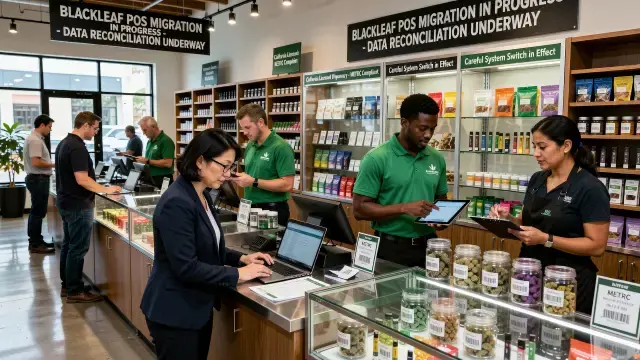
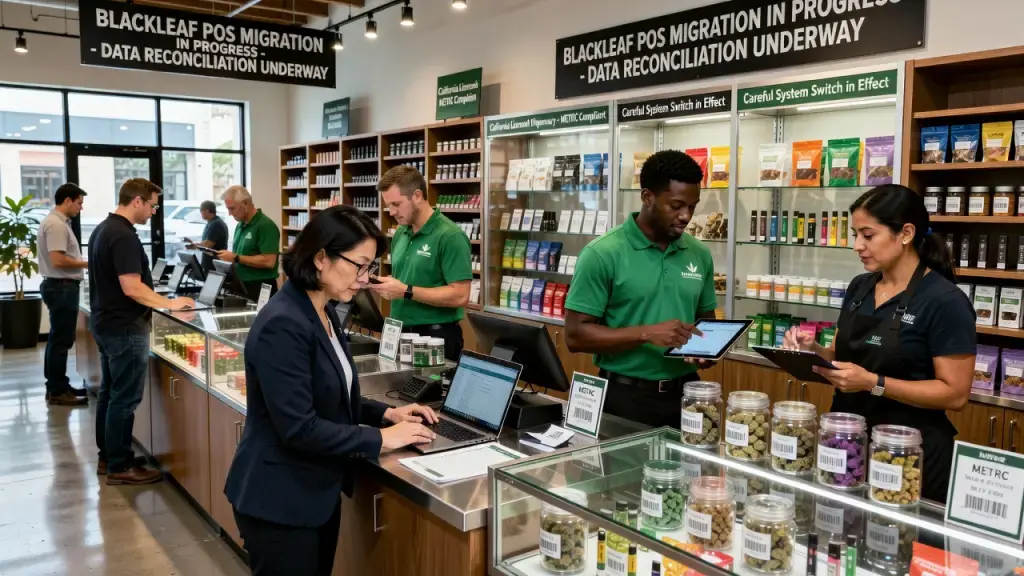
A point-of-sale rollout is never really about the terminals. It's about everything feeding into them - customer records, product catalogs, rewards balances, payment rails, and the people who have to make all of it work on launch day without the store grinding to a halt. Blackleaf's approach to onboarding dispensaries, starting with California-licensed locations, puts that reality front and center instead of treating the switch as a plug-and-play install.
Why a Store's History Shapes the Transition
Here's the catch with any retail system migration: the data is messier than anyone wants to admit. Customer files accumulate duplicates. Rewards ledgers drift out of sync with actual redemption activity. Product SKUs multiply across batch and package references until nobody's entirely sure which variant maps to which METRC tag. A dispensary that has operated for several years under one POS is carrying a history - and that history determines whether a new system launches clean or launches broken.
That's why a reconciliation step matters more than the software demo. Pulling a small, representative export first - rather than migrating everything at once - lets a team agree on field mapping and catch mismatches before they become a production problem. Customer identity matching, consent source documentation, and opening reward balances all need verification against the original system. Unavailable history should be flagged before cutover, not discovered after a budtender can't locate a regular customer's purchase record mid-transaction.
What Gets Reconciled
- Customer identity, duplicate records, contact details, and stated preferences
- Rewards balances, consent records, and any exclusions tied to loyalty history
- Product SKUs, variants, batch and package references, inventory holds, and on-hand quantities
- Open orders, payment states, returns, and what portion of order history actually exports
Rehearsal Over Assumption
In practice, a POS doesn't fail during the sales pitch. It fails during a return, an interrupted card payment, or a cash drawer that doesn't balance at close. Which is why a rehearsal shift - run with the actual front desk staff, budtenders, inventory leads, and managers who'll use the system daily - carries more weight than a vendor walkthrough. Check-in, a standard sale, a return, a pickup order, a receiving event, and a cash close should all get tested together, deliberately including a broken payment and a stock count that doesn't match the system.
Role-based training follows the same logic. A budtender needs different system fluency than an inventory manager tracking batch holds or a front-desk employee handling age verification and ID checks. Treating training as one generic session tends to produce staff who can run a sale but freeze the first time a transaction interrupts mid-payment - not a great moment in a regulated retail environment where every transaction needs a compliant audit trail.
What Operators Should Clarify Before Agreeing to a Launch Date
Fair enough - no software rollout promises a fixed go-live time, and it shouldn't. What a dispensary should expect, instead, is a documented cutover window, a final data check before the switch, and a fallback procedure if something breaks on day one. Support coverage needs the same clarity: who to call, what hours apply, how escalation works, and who owns an open issue until it's resolved. Migration fees and training scope belong in the commercial quote, not left as a verbal assumption.
A few structural points matter beyond the technical mechanics. Blackleaf's rollout is currently scoped to California, with licensed-location coverage confirmed there; other state coverage hasn't been announced, and jurisdiction-specific requirements - license type, tax reporting, payment processing rules - still need individual confirmation per store. Offline operation is on the roadmap but isn't production-ready yet, meaning operators should ask specifically what continues functioning without internet access, what's restricted, and how inventory and payment records reconcile once connectivity returns. And customer data migrating into a new system is not, on its own, marketing consent - a distinction that matters under state privacy expectations and shouldn't get blurred during a technical transition. There's no public self-service signup; interest in the system doesn't establish a launch date, and that's a reasonable guardrail for a company still rolling out one location at a time.