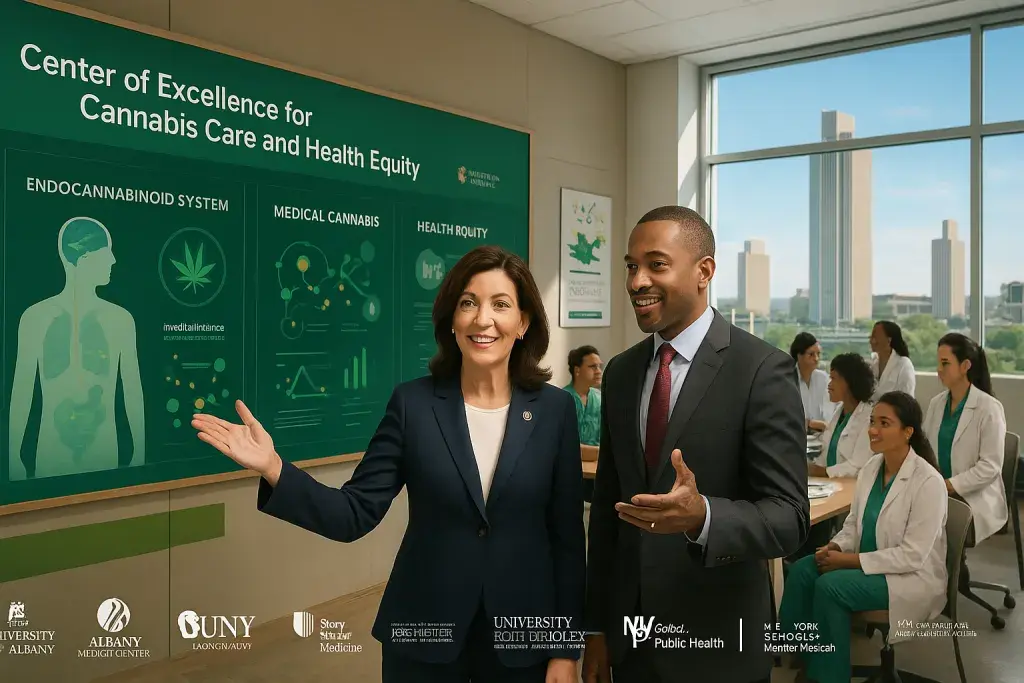
New York's Office of Cannabis Management has launched the Center of Excellence for Cannabis Care and Health Equity, a state-backed initiative designed to close a persistent knowledge gap among healthcare providers, public health professionals, and licensed dispensary workers. Announced formally by Governor Kathy Hochul in her 2026 State of the State address and brought online last week, the center represents a deliberate effort to weave public health infrastructure into a regulated cannabis market that was never meant to operate in isolation from the medical community.
The academic backbone here is substantial. The University at Albany and Albany Medical Center are anchoring the effort, with SUNY Upstate Medical University, Stony Brook Medicine, University of Rochester Medical Center, New York Institute of Technology College of Osteopathic Medicine, CUNY School of Public Health, and the New York State Office of Mental Health all participating. That breadth of institutional involvement - spanning osteopathic medicine, public health, and mental health systems - signals that OCM is building something more durable than a one-time training module. For dispensary operators keeping an eye on how other state markets are structuring their education and compliance requirements, resources like https://indicaonline.com/markets/ohio/ offer useful context on how regulated retail frameworks are taking shape across different jurisdictions.
OCM has also issued a request for proposals seeking qualified entities to design and deliver online asynchronous training covering the endocannabinoid system, medical cannabis, cannabis science, cannabis consumer health, and cannabis health equity. The intended audience is broad: medical practitioners, dispensary workers participating in or entering the state's medical cannabis program, community-based organizations, and state and local officials. Proposal applications closed in May.
What This Means for Dispensary Operations on the Ground
For operators running dispensaries in New York, particularly those with staff working across both adult-use and medical cannabis frameworks, this initiative is worth watching closely. The thing is, workforce training in cannabis retail has long been ad hoc - budtenders and dispensary managers picking up product knowledge informally, on the job, or through whatever compliance training a licensee cobbled together. A state-endorsed curriculum developed with accredited medical institutions sets a different standard, and it's reasonable to expect that standard to eventually inform what regulators consider acceptable for medical cannabis program staff.
OCM Executive Director John Kagia framed the launch around New York's public-health-first approach to legalization: "Our approach was about more than creating a new market. It's always been about building a framework rooted in public health, safety, education and equity." That framing matters for operators because it tells you something about regulatory direction - compliance in New York is unlikely to stop at seed-to-sale tracking and compliant packaging. Expect the OCM to keep building out requirements that touch consumer safety, staff knowledge, and health equity in meaningful ways.
Health Equity as a Structural Commitment, Not an Add-On
The center's explicit health equity mandate deserves its own look. New York's cannabis legalization framework was built with social equity as a foundational principle - prioritizing licenses for individuals and communities disproportionately affected by cannabis prohibition. Embedding health equity into a state-funded education center extends that commitment into the operational phase of the market. In practice, this means training that addresses how cannabis use affects different populations differently, how dispensary staff should approach vulnerable or high-risk consumers, and how public health systems can integrate cannabis education without stigma.
For multi-location operators and any dispensary with medical cannabis inventory, that intersection between consumer health education and frontline staff training is no longer theoretical. It's becoming part of the compliance architecture. A budtender who can speak accurately to a patient about a medical cannabis product - without making unsupported therapeutic claims - is both a consumer safety asset and a regulatory buffer. Training programs anchored in accredited medical institutions, as this center is, will carry more weight with regulators than internal onboarding materials alone.
The RFP and What Comes Next
The request for proposals to build the asynchronous training content is the mechanism that turns the center's framework into deliverable product. Online, asynchronous delivery matters here - it's the only format that scales across a state as geographically varied as New York, reaching dispensary workers in Buffalo, community health workers in the South Bronx, and rural practitioners upstate without requiring centralized attendance. Whether the resulting training will carry continuing education credits for medical professionals or formal certification for dispensary staff remains to be seen; those details will likely emerge as RFP selections are made and development begins.
What's clear is that New York is building an education infrastructure that treats cannabis retail and medical cannabis not as a compliance afterthought but as a public health system with working parts. Operators who engage with that infrastructure early - and who invest in staff training that aligns with what's coming from these institutions - will be better positioned than those waiting to see what becomes mandatory.