
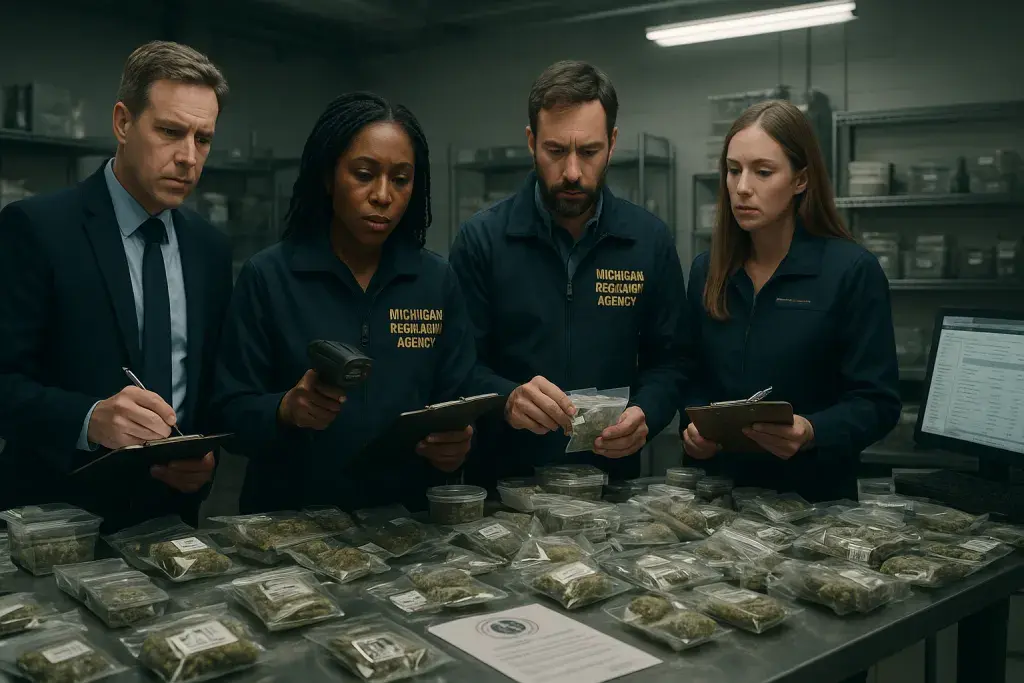
Michigan's Cannabis Regulatory Agency has filed a formal complaint against VJAS 1, a licensed cannabis processor operating out of Harrison Township, after an inspection turned up more than 12,000 individual cannabis products with no Metrc tags or identifying information. Among the untagged inventory: products packaged in California-specific labeling, bearing "CA" designations and California-mandated warning language - a detail that points investigators well beyond a simple record-keeping failure.
What makes this case particularly striking is not just the volume of unaccounted product, but the specificity of what was found. California's adult-use market operates under its own distinct packaging and labeling requirements - warning text, font sizing, and regulatory symbols that differ from Michigan's framework. Product carrying those markings sitting inside a Michigan processing facility, without any Metrc tags or chain-of-custody documentation, raises questions that go far beyond disorganized inventory management. For operators in other states who handle multi-market brands or distribute nationally sold product lines, it's worth noting how tightly regulators scrutinize interstate product movement - and how systems like dispensary software california operators use are built to maintain that state-specific compliance layer at every point of sale and distribution.
Inspectors also found products at the facility that did carry valid Metrc tags - but cross-referencing those tags against the seed-to-sale system revealed they were supposed to be at other licensed cannabis businesses entirely. That's not a clerical overlap. It means tagged inventory that regulators expected to be elsewhere was sitting inside VJAS 1's facility with no documented explanation for how it arrived there.
Why Metrc Integrity Is Non-Negotiable
Metrc - the Marijuana Enforcement Tracking Reporting Compliance system used by Michigan and more than two dozen other state-regulated markets - exists precisely to close the gap between the licensed supply chain and the illicit one. Every plant, every harvest batch, every finished product unit is assigned a unique radio-frequency identification tag. When a licensee receives product, transfers it, processes it, or destroys it, that movement is recorded. The system is the backbone of regulatory accountability in cannabis.
When 12,000-plus units appear in a licensed facility without those tags, the system has already failed at its most basic function. The CRA can't verify where that product came from, whether it was tested, whether it passed potency or contaminant screening, or whether it was legally produced under any state's regulatory framework. That's a consumer safety problem, not just a paperwork violation. Untracked cannabis products that move through the licensed supply chain undermine the entire testing and compliance structure that gives consumers assurance about what they're purchasing.
Employees at the facility, per CRA's account, could not explain the presence or origin of the untagged inventory. That kind of operational breakdown - in a licensed, regulated facility - suggests either a profound failure of internal controls or something more deliberate. Regulators will determine which. Either way, VJAS 1 is now facing potential fines, license suspension, revocation, restriction, and the possibility that its license simply won't be renewed.
The Broader Compliance Signal for Michigan Operators
This case should land as a clear signal for every licensed processor, retailer, and cultivator in Michigan's adult-use market. The CRA is conducting inspections that go beyond surface-level walkthroughs. Cross-referencing Metrc records against physical inventory, checking for out-of-state packaging markers, and tracing the supposed location of tagged product - that's methodical enforcement work. Operators who treat compliance as a checkbox exercise rather than an operational discipline are taking on real exposure.
For processors specifically, inventory control is both a compliance requirement and a basic business function. Knowing what product is on-site, where it came from, which batch it belongs to, and where it's going next isn't optional in a regulated market - it's the price of holding a license. Facilities that lack robust inventory management systems, real-time Metrc reconciliation, and clear receiving procedures are running a risk that the VJAS 1 case makes painfully concrete.
The presence of California-packaged product in a Michigan processing facility also raises broader questions about how unlicensed or out-of-state cannabis moves into regulated markets. Illicit market product flowing into licensed operations is not unique to Michigan; it's a documented pressure point in nearly every adult-use state. But that's exactly why regulators in these markets have built tracking systems and conduct inspections - to find what the ledger doesn't account for. In this case, the ledger had more than 12,000 answers it couldn't provide.