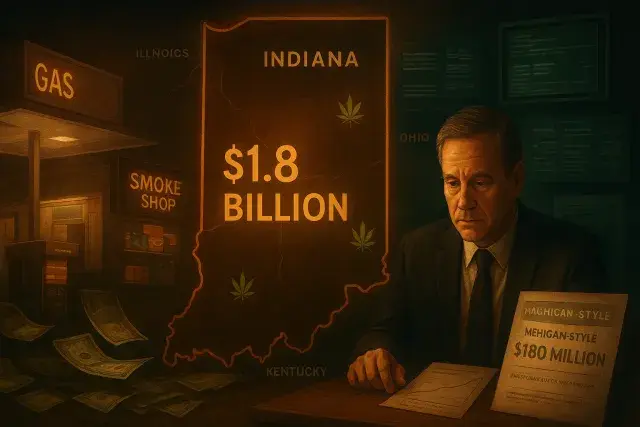
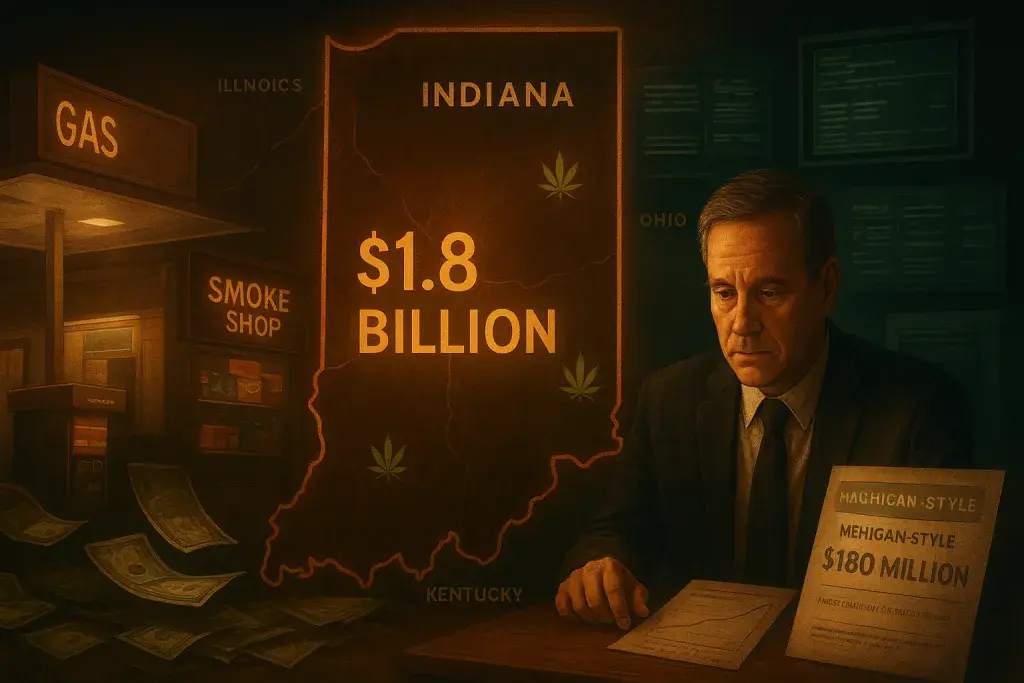
Indiana has the most restrictive marijuana laws in the country - and yet Hoosiers are spending an estimated $1.8 billion annually on cannabis products. That figure comes from a new study commissioned by the Richard M. Fairbanks Foundation and conducted by RAND, and it puts state lawmakers in an uncomfortable position: the prohibition is holding, legally, but the market clearly isn't.
The spending doesn't flow through a single channel, which is part of what makes this data so operationally interesting for anyone watching regulated cannabis markets. Nearly half of Indiana's population - roughly 3 million residents - lives within 50 miles of a legal dispensary in a neighboring state. Michigan, Illinois, Ohio, and Kentucky have each moved on cannabis legalization in some form, and border-state dispensary traffic is a well-documented retail phenomenon. Operators in those border markets have long optimized their POS systems, wholesale menus, and inventory management around out-of-state customer volume. States like Nevada, for instance, have built robust retail infrastructure - including cannabis pos software nevada platforms - specifically because high-volume, transient consumer bases demand tight seed-to-sale tracking and real-time compliance reporting. Indiana's neighbors are capturing that same demand, and the dollars are leaving the state with every tank of gas.
There's a second supply channel complicating the picture. Since the 2018 Farm Bill created a legal opening for hemp-derived cannabinoids, Indiana corner stores, gas stations, and smoke shops have filled their shelves with delta-8, delta-9, and other synthetically converted THC products. State law has offered little resistance. Researchers note - carefully - that the $1.8 billion estimate "likely includes some spending" on these hemp-derived products, because survey respondents weren't consistently distinguishing between traditional marijuana and the newer hemp-derived formats. That's an important caveat. What it means practically is that the true size of the traditional marijuana market, and the relative split between legal out-of-state purchases, hemp-derived retail sales, and black-market transactions, remains genuinely unknown.
Consumer Safety Is Getting Harder to Ignore
The unregulated nature of Indiana's de facto cannabis market carries real consumer-safety consequences. Cannabis-related calls to poison control centers in the state rose from roughly 200 annually in 2019 to a peak of around 500 in 2022. That spike tracks closely with the flood of hemp-derived THC products into unregulated retail environments - products that carry no required age verification at point of sale, no mandatory lab testing for potency or contaminants, no compliant packaging requirements, and no certificate of analysis readily available to consumers. A licensed dispensary in a regulated state operates under a compliance framework precisely to prevent these outcomes: COA verification, child-resistant packaging, purchase limits, ID checks. None of that infrastructure exists in an Indiana gas station selling a gummy packet with a hemp-derived THC claim on the label.
Congress has moved to close the hemp loophole effective this November, which would remove a significant portion of this unregulated product from shelves nationally. What happens in Indiana after that - whether consumption patterns shift toward out-of-state dispensaries, the black market absorbs more volume, or political pressure for a regulated in-state market intensifies - is an open question.
The Revenue Argument Isn't Landing. But the Pressure Is Building.
The RAND study models a scenario where Indiana legalizes cannabis under a tax structure similar to Michigan's, projecting state revenues could reach $180 million annually after five years. Legislative leaders have been direct in their response to this kind of math: revenue generation alone isn't sufficient justification for a policy shift of this magnitude. Fair enough. That's a legitimate position. But the conversation is shifting anyway.
Gov. Mike Braun, who took office after running without a clear stance on medical marijuana, has described himself as "kind of agnostic" on legalization and has acknowledged publicly that Indiana may have to confront the issue - surrounded as it is on all sides by states that have already moved. Republican lawmakers have filed cannabis-related bills in recent sessions. The trend lines on consumption aren't reversing: the share of Hoosiers age 12 and older reporting past-month cannabis use more than doubled between 2012 and 2024, from 6.2% to 15.5%, with roughly half of those users consuming on a daily or near-daily basis.
What's striking here is that Indiana isn't an outlier in terms of consumption behavior - it's an outlier in terms of regulatory response to that behavior. The $1.8 billion is leaving the state economy, flowing into neighboring licensed markets and unregulated retail, generating tax revenue elsewhere, and producing compliance and safety gaps at home. For operators, investors, and compliance professionals watching this state, the calculation isn't whether a market exists. It clearly does. The question is what regulatory structure, if any, eventually organizes it.