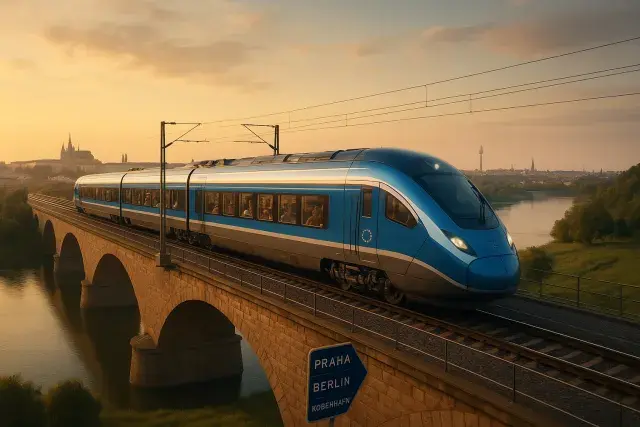

A direct passenger rail service linking Prague, Berlin, and Copenhagen has entered regular operation, connecting three major European capitals through a single continuous corridor for the first time. The route, developed under a coordinated framework involving railway operators from the Czech Republic, Germany, and Denmark, reflects the European Union's broader push to reposition international rail as a credible alternative to short-haul aviation across the continent. End-to-end journey time runs approximately 11 hours and 45 minutes - not fast enough to beat a flight, but competitive once airport processing, city-to-center transfer times, and checked baggage friction are factored in.
The launch marks one of the more consequential steps in a wider EU pilot program testing new cross-border corridors. That program shares a structural logic familiar to operators in other regulated industries: before scaling, you test. Before committing infrastructure investment, you measure uptake, identify friction points, and adjust. Businesses tracking how regulatory frameworks shape technology adoption - from dispensary software in Massachusetts to rail interoperability standards in Central Europe - will recognize the pattern. Pilot frameworks exist because large-scale integration across different national systems is genuinely hard, and the coordination costs are front-loaded.
What the Corridor Actually Looks Like in Operation
The service currently runs two daily return trips along with a seasonal overnight option. Rolling stock was supplied by the Czech Republic and engineered for compatibility across multiple national rail networks - a non-trivial requirement given that European rail systems were built independently over more than a century and still carry significant technical divergence in electrification, signaling, and track gauge. Onboard features include high-speed connectivity, full-service dining, dedicated bicycle storage, and seating configured for extended travel durations. The design signals an intent to compete on comfort, not just price or schedule.
Here's the catch, though. Between mid-July and mid-August, infrastructure maintenance at a major German rail hub will require passengers on certain segments to change trains, temporarily breaking the fully direct connection. Replacement bus operations in Denmark on selected days will extend overall journey times further. That timing - peak summer travel season - is about as inconvenient as it gets for a service trying to build initial ridership. The works are necessary for long-term network reliability, but the optics of launching a "direct" service and then temporarily suspending its direct character within weeks of opening are worth noting plainly.
Where Demand Is Expected to Concentrate
Rail operators are clear-eyed about the likely demand distribution. Prague-Berlin and Berlin-Hamburg segments are expected to carry the heaviest passenger loads, given established economic and tourism flows between those cities. Full end-to-end travel between Prague and Copenhagen is a different proposition - a roughly 12-hour rail journey is a deliberate choice, not a default one, and operators acknowledge it will take time before that segment builds meaningful volume.
That pattern is consistent with how most new long-distance corridors perform: intermediate segments carry the early load while end-to-end demand grows gradually as the service earns reliability and awareness. What's striking here is that operators are saying so openly, rather than projecting optimistic full-route utilization figures. That kind of measured framing suggests the corridor is being treated as infrastructure with a long maturation curve - which is probably the right way to think about it.
The Broader Transport Agenda Behind the Route
The Prague-Berlin-Copenhagen corridor sits within a larger EU framework aimed at modal shift - moving passenger traffic from aviation and road toward rail on medium-distance routes. Short-haul flights are a significant source of carbon emissions relative to their transport value, and European policymakers have been explicit about wanting rail to absorb a larger share of that market. The new corridor is one operational expression of that goal.
What the launch demonstrates, practically, is that cross-border rail integration in Europe is being treated as core infrastructure rather than an amenity. Interoperability, timetable coordination, and consistent passenger experience across national borders are the operating principles - not unlike how modern supply chain and compliance systems in regulated industries are increasingly built around interoperability across jurisdictions, rather than isolated national or state-level deployments. The corridor's performance over the next two to three years will carry real weight in decisions about which additional routes get prioritized and funded across the continent.