
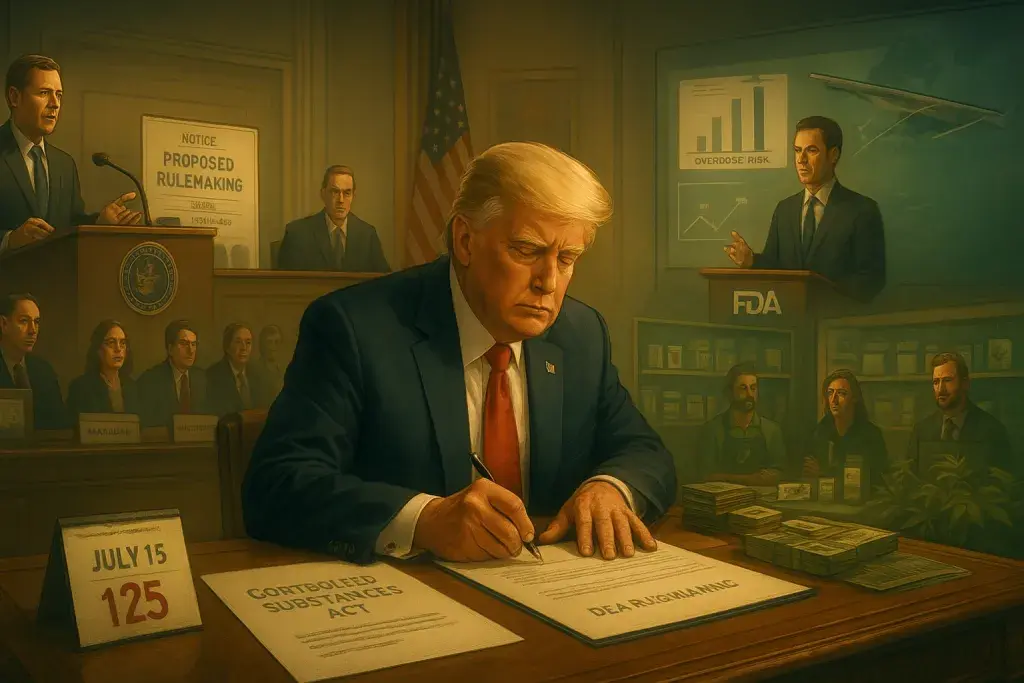
A December 2025 executive order signed by President Donald Trump directed federal agencies to expedite the rescheduling of cannabis from Schedule I to Schedule III under the Controlled Substances Act - the most significant shift in federal cannabis policy since that law took effect in 1971. The order set in motion a formal rulemaking process now unfolding through a DEA administrative hearing, with a mandated conclusion date of no later than July 15, 2026. For licensed cannabis operators across the country, the financial stakes could not be higher.
Acting Attorney General Todd Blanche issued a notice of proposed rulemaking and called on "every interested person" to file written notice of their intention to participate in the hearing. In practice, though, only cannabis opponents were selected as participants - a list that includes the Smart Approaches to Marijuana advocacy group, the states of Nebraska, Idaho, Indiana, and Louisiana, the National Drug & Alcohol Screening Association, the Tennessee Bureau of Investigation, and several individual medical professionals. Operators in states with mature adult-use or medical cannabis markets - including those who want to learn more about how compliant retail technology supports licensed dispensary operations - are watching this process closely, given its direct implications for how their businesses are taxed and structured at the federal level.
The participant list has drawn pointed criticism from reform advocates. Because the rescheduling proposal originated with the DEA itself, the agency is serving as the proponent of reform throughout the hearing - meaning only opponents are permitted to testify against it. As the Marijuana Policy Project noted, this marks the first time in the DEA's history that the agency will formally argue cannabis meets the established criteria for removal from Schedule I: accepted medical value and a moderate to low potential for addiction and abuse. That is a significant institutional about-face, and the adversarial structure of the proceeding adds a procedural tension that observers are tracking carefully.
What the FDA Said on the Record
During the first day of hearings, an FDA official testified that the agency compared cannabis to alcohol, opioids, and other controlled substances when conducting its scheduling analysis. According to reporting by Marijuana Moment, the FDA official stated that cannabis was associated with fewer overdose deaths than comparator substances and that when cannabis appears in fatality case reports, deaths are typically attributed to secondary events - accidents or self-harm - rather than to cannabis itself. The official described cannabis's overdose death potential as "much lower" than other Schedule I drugs as well as Schedule II opioids.
None of that testimony was available to the public in real time. A coalition led by Marijuana Moment, joined by at least one member of Congress, formally requested that DEA Chief Administrative Law Judge Derek Julius and DEA Administrator Terrance Cole allow the proceedings to be livestreamed. That request was denied. Members of the public had no direct window into the hearing; Marijuana Moment's coverage relied on accounts from individuals present in the room.
The 280E Problem - and What Rescheduling Actually Fixes
Here's the catch that has defined cannabis business economics for years: Section 280E of the Internal Revenue Code prohibits any business engaged in the "trafficking" of a Schedule I or II substance from deducting ordinary business expenses from gross income. That means a licensed dispensary cannot deduct rent, payroll, marketing costs, or most operating expenses the way any other retail business would. The effective tax burden on cannabis operators under 280E is substantially higher than for comparable businesses in conventional retail - a structural disadvantage baked into the federal tax code since the law was written, long before state-legal cannabis markets existed.
Moving cannabis to Schedule III removes it from the 280E dragnet entirely. State-legal cannabis businesses would then be able to deduct standard operating expenses, bringing their effective tax treatment closer to that of other licensed retail or consumer goods businesses. The aggregate savings across the U.S. industry would run into the billions of dollars annually - capital that operators could redirect toward store expansion, inventory investment, workforce development, or compliance infrastructure. Multi-state operators carrying significant debt loads would feel this change most immediately in their cash flow and balance sheet management.
What rescheduling does not do: it does not legalize cannabis at the federal level. Dispensaries would still operate under state licensing frameworks. Banking access, interstate commerce restrictions, and federal employment law complications would not automatically resolve. The compliance obligations that govern seed-to-sale tracking, lab testing, compliant packaging, and point-of-sale reporting under state law remain entirely intact. Operators should not mistake a tax reclassification for a federal green light - it is a meaningful but partial change.
The International Dimension Operators Should Track
Rescheduling also opens a door that has been effectively closed to U.S. cannabis companies: participation in international medical cannabis export markets. Several European markets have developed regulatory frameworks for medical cannabis imports, and U.S. producers - blocked by federal Schedule I status from engaging with those frameworks - have largely been absent from that trade. A move to Schedule III would not instantly resolve every regulatory hurdle, but it would remove one of the most fundamental legal barriers preventing U.S. licensed cultivators and manufacturers from positioning themselves as export-ready suppliers.
For vertically integrated multi-state operators with established cultivation and processing capacity, this is worth watching closely. European medical cannabis markets have grown steadily, and entry requires meeting both domestic and destination-country compliance standards - including product testing, chain-of-custody documentation, and packaging requirements that differ materially from U.S. state-level rules. Operators serious about international expansion will need to assess their production and compliance infrastructure long before any export opportunity becomes actionable.
The hearing continues. The formal record is still being built. And the outcome - whenever it arrives - will carry consequences that reach from a dispensary's tax bill to its long-term growth strategy. Whatever one thinks of the process itself, the business implications of federal rescheduling are real, and licensed operators have every reason to follow it with the same attention they give to their state compliance calendar.