Planet 13 Holdings reported second-quarter revenue of $22.9 million, down 14.9% from a year earlier, but with gross margin expansion and a sharply reduced net loss that suggest the multi-state operator's cost-cutting is taking hold ahead of a pending merger with Vireo Growth Inc. The Las Vegas-based company posted the results for the quarter ended June 30, 2026, a period defined less by growth than by consolidation - of costs, of footprint, and, soon, of corporate identity.
A Smaller Top Line, A Healthier Margin
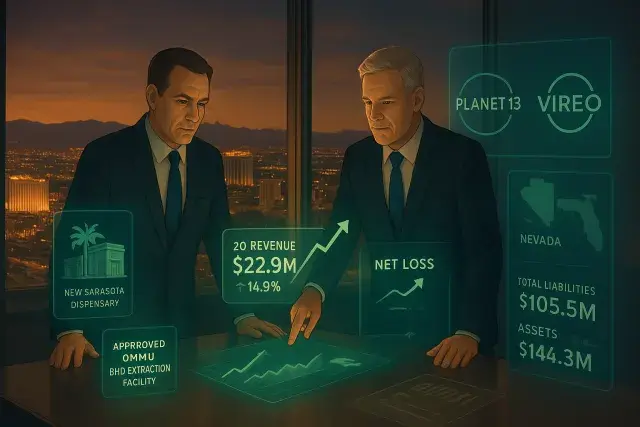
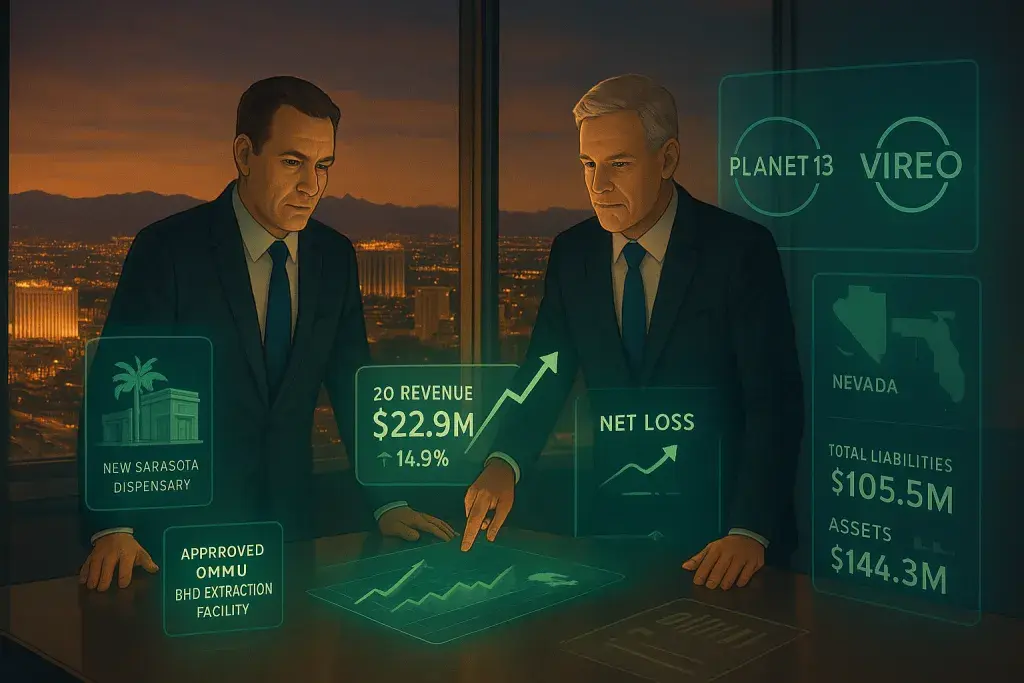
The revenue decline traces back to a deliberate retreat: Planet 13 exited California retail and wholesale operations, a market that had become a drag on margins amid persistent price compression. That exit, combined with company-wide procurement initiatives, pushed gross margin to 53.9% from 43.4% a year prior. Strip out a one-time $1.0 million reduction in the inventory reserve tied to Florida distillate, and adjusted gross margin still came in at 49.5% - a meaningful improvement for an operator that has spent the last several quarters fighting wholesale price erosion in Nevada and Florida alike. Total expenses fell 17.7% to $15.2 million, evidence that the cost discipline extends beyond cost of goods sold into overhead and operating structure.
Florida's Rebound and the Limits of Regional Fixes
Florida revenue climbed 17.1% quarter over quarter, a figure Co-CEO Larry Scheffler pointed to as proof the company's efforts to stabilize that market are working. The state has been a mixed bag for multi-state operators: a large, medically-driven patient base offset by intense retail competition and, for Planet 13 specifically, excess distillate inventory that necessitated reserve write-downs. The OMMU approval for a Florida BHO extraction facility, granted in May, gives the company more control over its product pipeline there - a hedge against the kind of oversupply that dented margins in prior quarters. Still, one state's rebound doesn't offset a broader market where price compression remains structural, not cyclical, in states with mature adult-use programs.
Why the Vireo Merger Changes the Calculus
Co-CEO Bob Groesbeck was direct about the strategic logic: the market increasingly rewards scale, purchasing power, and balance-sheet depth to absorb continued price compression. That's a candid admission from an operator that built its brand on flagship, experience-driven dispensaries rather than sheer footprint. The definitive merger agreement with Vireo Growth, announced July 27, is meant to address exactly that gap - giving Planet 13 shareholders equity in a combined entity with broader distribution and presumably better wholesale leverage. Because the deal is pending, Planet 13 opted not to hold a quarterly conference call, a practical but telling signal that management's attention is now split between running the business and closing the transaction.
What Operators and Investors Should Watch
For multi-state operators watching from the sidelines, Planet 13's quarter is a case study in how a mid-size vertically integrated company manages contraction without collapsing. The playbook: exit unprofitable markets, tighten procurement, work down excess inventory, and consolidate where scale is unavailable organically.
- Balance sheet strain persists - total liabilities rose to $105.5 million against total assets of $144.3 million, a ratio worth monitoring through the merger close.
- Adjusted EBITDA loss narrowed to $0.5 million from $2.4 million, but the company remains unprofitable on an operating basis.
- Continued Florida expansion, including the upcoming Sarasota store, signals confidence in that market even as the merger process unfolds.
- 280E tax exposure and state-level excise structures continue to pressure margins industry-wide, independent of any single company's cost initiatives.
None of this changes the underlying reality facing cannabis retail: compliance costs, tax treatment under federal law, and wholesale price compression aren't going away. Consolidation, for operators like Planet 13, isn't a strategy of choice so much as a response to a market that has stopped rewarding independence for its own sake.