
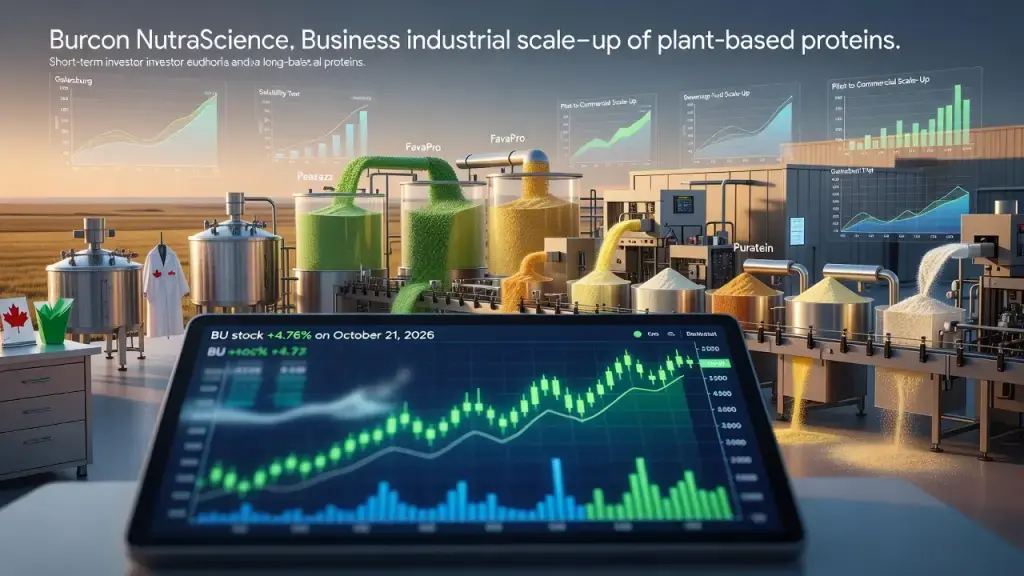
Shares of Burcon NutraScience Corporation (TSX:BU) climbed 4.76% on October 21, 2026, a single-session move that traders will read as a signal but operators in the plant-protein ingredient business will want more evidence before calling a trend. The Canadian food technology company develops and licenses proprietary extraction methods for pea, fava and canola proteins, selling into beverage, nutrition and food manufacturing channels. No specific company catalyst for the day's move has been confirmed, which matters - a one-day pop without a clear trigger is sentiment, not necessarily substance.
What's Actually Driving the Story
Burcon isn't a protein brand consumers buy off a shelf. It's an ingredient supplier and IP licensor, meaning its revenue depends on getting food and beverage manufacturers to adopt its Peazazz, FavaPro and Puratein lines at commercial volume - then reorder. That's a slower, more grinding path to profitability than a direct-to-consumer story, and it's why the market tends to react to incremental signals: a manufacturing upgrade, a customer pipeline comment, a production efficiency note. The company has been investing in its Galesburg manufacturing capability specifically to move past pilot-scale output and toward the kind of reliability that food manufacturers require before they'll commit to a supply contract.
Here's the catch with ingredient-technology plays like this one: differentiation on paper - solubility, functionality, taste-masking - only converts to revenue once a customer's own product line proves out at scale. Food manufacturers are conservative buyers. They test, reformulate, test again, and only then place recurring orders. That cycle can take quarters, not weeks, which is part of why near-term share moves often outrun the underlying commercial timeline.
Risk Factors Worth Weighing
Investors and supply-chain partners evaluating Burcon should keep a short list of pressure points in view:
- Execution risk - scaling manufacturing output without sacrificing consistency is harder than it sounds on an investor call
- Funding risk - further capital raises could dilute existing shareholders if commercial ramp-up requires more cash than expected
- Competitive pressure - larger, better-capitalized ingredient suppliers have existing distribution relationships Burcon would need years to replicate
- Macro exposure - broader inflation or transportation-cost pressure, including from geopolitical tension, could raise input costs indirectly rather than through any direct operational link
- Regulatory exposure - ingredient approvals, labeling rules and food-safety standards still govern market access regardless of technical performance
Reading the Chart Versus Reading the Business
From a trading perspective, analysts will watch whether the stock holds recent consolidation levels as support, and whether it can clear prior resistance on real volume rather than thin, momentum-driven activity. Sustained participation would say more than a single green day. But - and this is the point worth repeating - chart behavior and commercial fundamentals are different conversations. A stock can trend up while the underlying business still faces a multi-quarter slog toward consistent manufacturing output and repeat orders.
Burcon is not positioned as an income investment; there's no dividend narrative here. Its case rests entirely on whether management can convert manufacturing investment and customer interest into durable, margin-positive ingredient sales. That's a commercial execution question, not a market-sentiment one, and it will take several reporting periods - not one trading session - to answer properly.