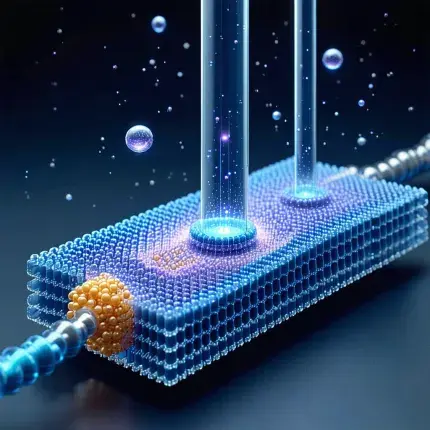

In a breakthrough for quantum computing, scientists have identified a magnetic-field configuration that eliminates the longstanding trade-off between operation speed and coherence in two-level systems (TLSs), the foundational units of quantum computers. Using an InAs nanowire device coupled to a superconducting resonator, this "compromise-free sweet spot" maximizes dipole coupling while minimizing dephasing, promising faster, more stable qubits.
The Persistent Challenge in Quantum Two-Level Systems
Two-level systems, or TLSs, underpin quantum processors by encoding qubits as transitions between two quantum states, such as the singlet-triplet (S-T⁺) pair in spin qubits. However, shared coupling paths for control and readout create a fundamental dilemma: boosting speed via stronger dipole interactions often amplifies noise, shortening coherence times essential for reliable computation. Traditional optimizations, like gate-voltage sweet spots, fall short for spin-based TLSs, where scaling demands all-electrical control amid weak dipole moments.
Unlocking the Sweet Spot Through Spin-Orbit Interaction
Leveraging the inherent spin-orbit interaction (SOI) in InAs nanowires, researchers engineered a crystal-phase-defined double quantum dot hosting an S-T⁺ TLS. By tuning the in-plane magnetic field orientation—particularly along the nanowire—they achieved maximal spin-photon coupling alongside minimal total dephasing. Key measurements via a high-impedance NbTiN resonator revealed:
- Gigahertz-scale SOI hybridization gap between |S⟩ and |T⁺⟩ states.
- Strong coupling limit with microwave resonators, extending to spin-photon interfaces.
- Phonons identified as the dominant noise source in their theoretical model.
This orientation-specific optimization, rooted in SOI, transcends gate-voltage tweaks and proves resilient to magnetic fields, unlike micromagnet-dependent schemes.
Broad Implications for Next-Generation Qubits
This discovery signals a paradigm shift for semiconductor spin qubits, which already offer long coherence and silicon-compatible fabrication. By decoupling speed from decoherence, it eases scaling challenges, potentially enabling fault-tolerant quantum computers with thousands of qubits. Applicable to any SOI-rich material—from nanowires to 2D systems—the approach invites nanomaterial engineering advances. As quantum tech races toward practical applications in drug discovery, cryptography, and optimization, such physics-driven insights could accelerate the transition from lab prototypes to deployable hardware, bolstering global efforts in secure computing and scientific simulation.