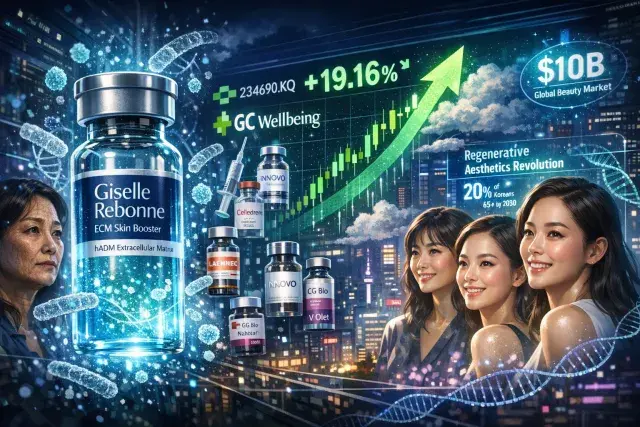
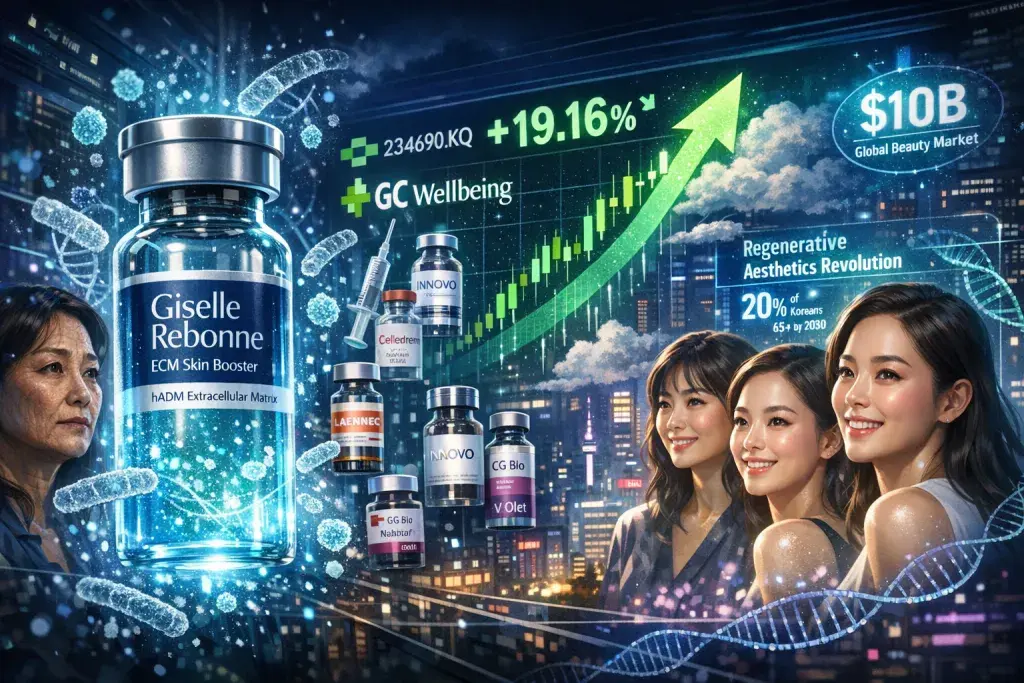
On October 25th, shares of GC Green Cross Wellbeing (234690.KQ) rocketed 19.16% to 14,680 won on the Korea Exchange, fueled by the domestic debut of "Giselle Rebonne," a human-derived extracellular matrix (ECM) skin booster. This leap underscores the explosive growth in regenerative aesthetics, where cutting-edge biotech meets soaring consumer demand for transformative skincare.
Unpacking Giselle Rebonne's Edge
Giselle Rebonne stands out as a next-generation skin booster derived from human acellular dermal matrix (hADM), a biomaterial stripped of cells to eliminate immune risks. Unlike traditional boosters that merely stimulate collagen indirectly, this delivers the ECM scaffold directly, enabling true tissue remodeling and structural skin restoration.
- Proprietary decellularization by MS Bio removes immune triggers, boosting biocompatibility.
- Processed via GC Green Cross Wellbeing's Eumseong tissue bank for stringent quality control.
- Offers regenerative effects rivaling more invasive procedures, with minimal downtime.
In an era of precision medicine, such innovations shift aesthetics from cosmetic tweaks to biological rejuvenation, appealing to those seeking lasting skin health amid urban stress and aging.
Strategic Moves in a Competitive Landscape
GC Green Cross Wellbeing is fortifying its aesthetic portfolio with Giselle Rebonne alongside stars like placenta injection "Laennec," dermal fillers, skin boosters, and botulinum toxin "Innovo." This mirrors rivals: Hugel (145020.KQ) eyes co-promotion with Hans Biomed's "Cellrderm," while CG Bio plans ECM launches tied to Daewoong's "Nabota" and "V-Olet."
The strategy taps South Korea's dominance in global beauty tech, where the aesthetic market exceeds $10 billion annually, driven by K-beauty exports and domestic procedures per capita leading the world.
Implications for Regenerative Beauty Trends
This surge signals a paradigm shift toward ECM-based therapies, potentially reshaping non-surgical aesthetics. With biocompatibility minimizing inflammation, products like Giselle Rebonne could democratize advanced regeneration, reducing reliance on synthetics prone to rejection.
Broader trends point to an aging Asia-Pacific population—over 20% of South Koreans are 65+ by 2030—fueling demand for safe, effective anti-aging. Yet challenges loom: regulatory scrutiny on human-derived materials and pricing accessibility will test scalability. For investors and consumers, it's a bullish bet on biotech's beauty revolution.