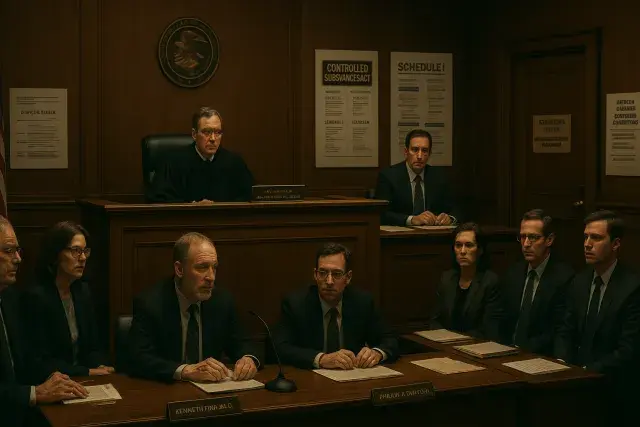
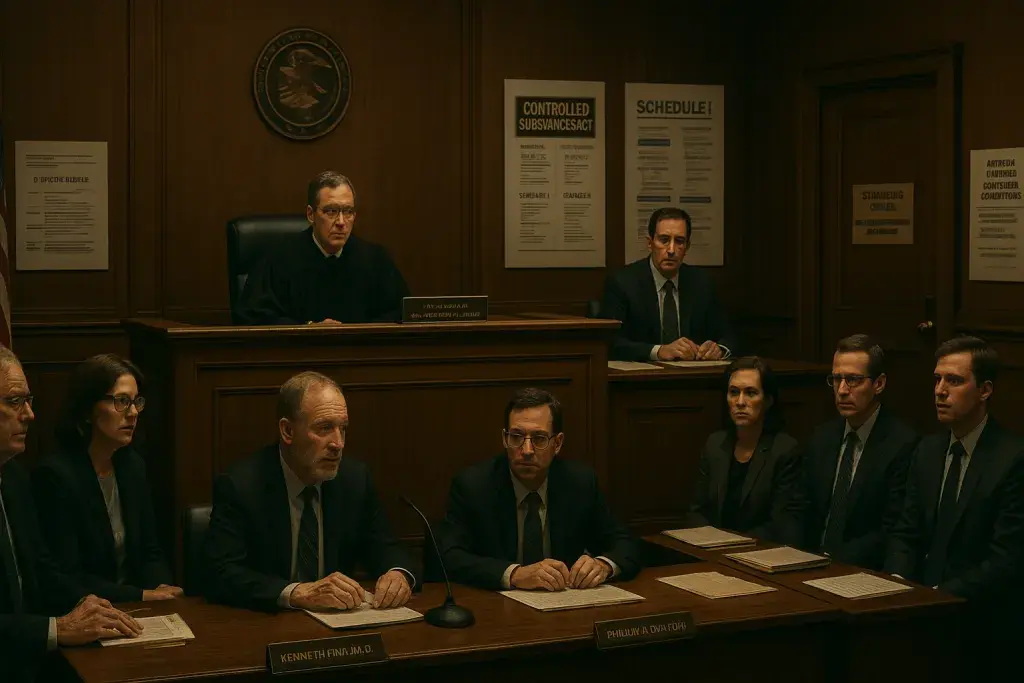
The Drug Enforcement Administration's cannabis rescheduling hearing now has a firm timeline and a narrow participant list - and the administrative law judge overseeing the proceedings has made one thing unmistakably clear: if you're not a designated party, don't bother sending anything in. Derek C. Julius, the DEA's new chief administrative law judge, published the hearing's detailed schedule on June 24, setting a day-by-day, hour-by-hour calendar running from June 29 through July 15 for the DEA and seven anti-rescheduling participants to present opening briefs, witness testimony, and cross-examinations. For licensed cannabis operators, multi-state companies, and the compliance professionals who advise them, this hearing may be the most consequential federal regulatory proceeding in the industry's modern history - and it's proceeding without a single pro-rescheduling voice in the room.
The stakes extend well beyond federal scheduling categories on paper. How cannabis is classified under the Controlled Substances Act determines whether plant-touching businesses remain locked out of standard banking relationships, whether Section 280E of the tax code continues to deny dispensaries ordinary business deductions, and whether interstate commerce ever becomes a realistic operational model. Operators running compliant cannabis POS in Arizona and every other state-licensed market are still building businesses under a federal Schedule I designation that treats their inventory the same as heroin - and the outcome of this hearing will determine whether that changes, stays the same, or potentially gets worse, since the DEA retains authority to issue a final rule at Schedule II or maintain Schedule I entirely.
A Hearing Built Around Opposition
The participant roster tells the story plainly. The DEA set the hearing's agenda on June 18, when Administrator Terry Cole selected seven anti-rescheduling organizations to participate. The list includes Smart Approaches to Marijuana, the National Drug and Alcohol Screening Association, DUID Victim Voices, the Tennessee Bureau of Investigation, the States of Nebraska, Idaho, Indiana, and Louisiana, and two individual expert witnesses - Kenneth Finn, M.D., and Phillip A. Drum, Pharm.D. Every designated participant opposes reclassification. The DEA itself, which bears the burden of proof as the proponent of the proposed Schedule III rule, has formally noted that it has not yet made a determination about what schedule it actually supports. So the lone advocate for rescheduling in these proceedings is an agency that hasn't committed to the position it's been ordered to argue.
Pro-rescheduling petitioners were rejected on the grounds that they don't meet the regulatory definition of an "interested person" - specifically, a person "adversely affected or aggrieved by any rule or proposed rule issuable." That's a striking application of the standard. NORML, the national cannabis reform advocacy group, sent DEA Administrator Cole an emergency reconsideration request on June 19, arguing that the determination mischaracterized NORML's actual position and that excluding the organization would cause procedural prejudice and impair the completeness of the administrative record. The veterans advocacy group Hemp for Victory, which had previously qualified under that same interested-person standard under former DEA Administrator Anne Milgram, was also turned away - after Acting Attorney General Todd Blanche withdrew the Biden-era hearing process entirely in April and ordered a fresh start under the Trump administration.
The ALJ Has Drawn Hard Lines
Julius issued a standing order on June 23 - the day before releasing the hearing schedule - making clear that the participation list is final and that it is not within the tribunal's authority to disturb the administrator's analysis. "All other submissions in this forum concerning this matter by non-parties lack standing and will not be considered," he wrote. That's not procedural boilerplate. Julius received communications from non-parties before the hearing even began, which suggests the volume of outside interest was significant enough to prompt a preemptive order. The message is straightforward: the lineup is set, and no motion, emergency request, or outside submission will change it at this stage.
Julius also narrowed the evidentiary scope in a way that adds considerable complexity to the DEA's burden of proof. His preliminary order excludes evidence or testimony on state-licensed medical cannabis or FDA-approved cannabis products - because Acting AG Blanche's April order already reclassified those products at Schedule III. What remains, then, is the question of whether nonmedical, adult-use cannabis has "currently accepted medical use" in the United States. That's the standard any substance must meet to be classified below Schedule I, and it's a high bar under federal law. The DEA now has to make that case, under oath and subject to cross-examination, with no supporting witnesses from the medical cannabis community, advocacy organizations, or the licensed industry itself allowed in the room.
What Operators Should Watch and Why
The hearing must conclude no later than July 15 under Acting AG Blanche's order - a tight window for proceedings of this complexity. Julius has reserved the right to modify the schedule as needed, and parties may conclude examinations early or forgo cross-examination, which could accelerate the timeline. After the hearing closes, the process moves to post-hearing briefing and ultimately a recommended decision from the ALJ, which the DEA administrator can adopt, modify, or reject. A final rule then goes through the standard rulemaking process, including public comment, before taking effect.
Here's the thing: even a favorable outcome - a final rule placing cannabis at Schedule III - would not legalize adult-use cannabis federally, would not resolve state-federal conflicts over licensed operators, and would not automatically fix 280E exposure or banking access. Schedule III status would remove cannabis from the most restrictive federal classification, but the operational compliance burden on dispensaries, cultivators, and processors would remain substantial. What the hearing's outcome genuinely affects is the trajectory of those downstream policy questions - the banking reform conversations, the tax treatment debates, and the longer-term discussion about whether a federal licensing framework ever materializes.
Licensed operators watching this process should understand that the hearing's structure, whatever its procedural limitations, produces a formal administrative record. That record will be cited in litigation, referenced in future rulemaking, and used by both sides in whatever legal challenges follow. The industry has no seat at the table this time. But the table still matters.