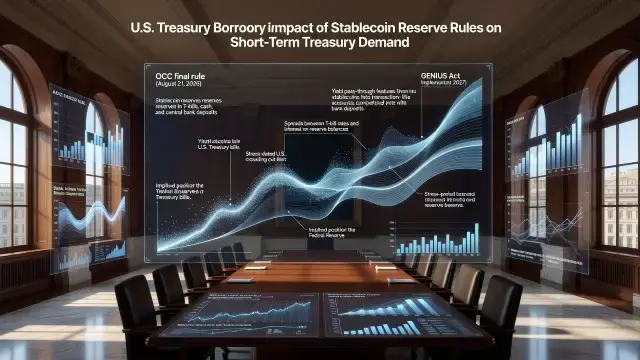
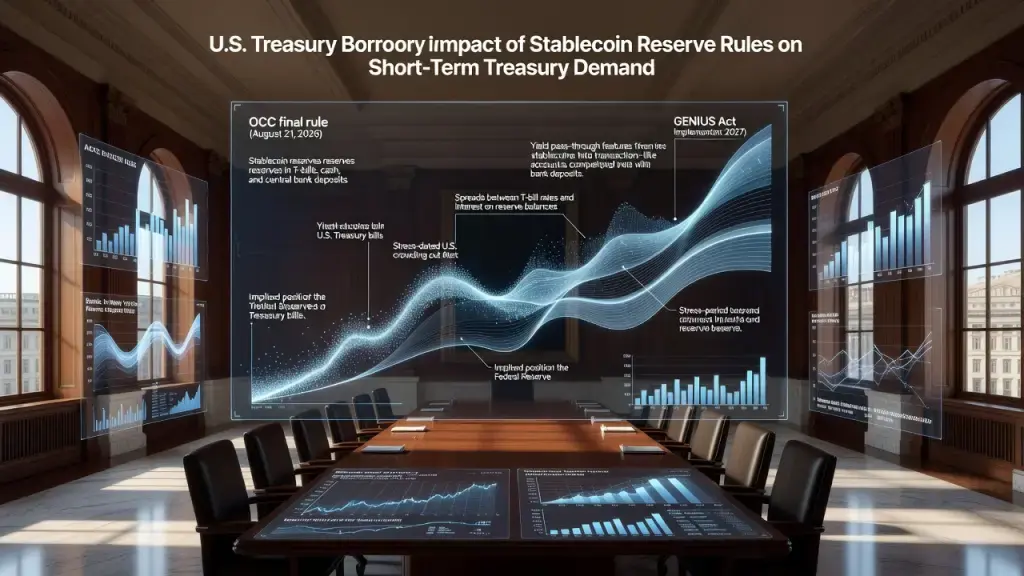
The Treasury Borrowing Advisory Committee, a panel of private-sector financial experts that advises the Treasury Department, has concluded that mandatory stablecoin reserve requirements could concentrate demand sharply in the front end of the yield curve. The finding, reported October 24, carries weight because it comes from the same advisory body that helps shape how the federal government thinks about its own debt issuance. The committee was careful to note that the scale of the effect depends on two unresolved variables: the final shape of the U.S. regulatory framework and how large the stablecoin market eventually grows.
Why Treasury Bills Became the Center of the Debate
Under the OCC's final rule, published August 21, 2026, stablecoin issuers must hold reserves predominantly in short-dated U.S. Treasury bills, cash, and central bank deposits. That is not a minor technical detail. An issuer with billions in circulating stablecoins becomes, by regulatory design, a large and recurring buyer of short-term government paper - one that must constantly roll that paper to maintain liquidity. The TBAC's concern is straightforward: a buyer that size, behaving in a fairly mechanical way, could compress bill yields and narrow the spread between T-bill rates and interest on reserve balances. Critics worry this crowds out other short-term investors during periods of stress. Supporters counter that tying stablecoins to the deepest sovereign debt market in the world is exactly the kind of stabilizer regulators should want.
The Deposit Question Regulators Can't Ignore
Here's the part that matters for banks. The TBAC's analysis states plainly that deposit effects "may depend on stablecoins' yields and payment features." If stablecoins remain non-interest-bearing instruments used mainly for settlement, banks face limited competitive pressure. But the GENIUS Act has begun clarifying how issuers can pass through yield, and once a stablecoin pairs a competitive yield with instant settlement and programmability, it starts looking a lot like a transaction account - minus the branch network. Banks could respond by raising deposit rates to retain balances, or by leaning more heavily on wholesale funding, which tends to be less stable and more sensitive to market swings. That is a real structural question for bank funding costs, not a hypothetical one.
Open Questions Through 2027
The OCC's rule is final, but GENIUS Act implementation stretches into 2027, and legal challenges remain possible. Meanwhile, states including Wyoming and Nebraska continue advancing their own special-purpose depository charters for digital assets, raising the possibility of divergence between state and federal reserve standards. For market participants - banks, money market funds, corporate treasurers, and stablecoin issuers alike - the open question is not whether reserve rules will matter, but how much, and how fast the stablecoin market has to grow before the TBAC's front-end concentration concern becomes a measurable market event rather than an advisory committee's forecast.